It’s absolutely delicious when made well.
It impresses guests and significant others, because it’s exotic.
It’s dead easy to make, even if you’re a kitchen klutz…
…and nearly every recipe I’ve found on the Internet is wrong. Most of them produce gravlax that is either raw in the middle, hard and crusty on the outside, or tastes like a Styrofoam salt lick—which is a tragedy, because properly made gravlax is so delicious that I’ve eaten over a pound and a half at a single sitting! And the others make you go to a lot of extra work.
It’s taken several expensive experiments to get this recipe correct—and now I bring it to you.
Gravlax, Gravad Lax, Gravet Laks, Gravlaks, Graflax, Graavilohi, Graavilõhe
Gravlax (also known as gravad lax, gravet laks, gravlaks, graflax, graavilohi, or graavilõhe, depending on which Nordic country you’re from) was traditionally made by salting salmon and burying it in a hole dug at the ocean’s edge, just above the high tide line. Today we will improve on that technique by using refrigeration and fresh herbs.
Why This Gravlax Recipe Is The Best
First, I’ve stripped the process down to the essentials, skipping steps that don’t matter and streamlining the rest.
More importantly, though, most gravlax recipes add far too much salt—and then depend on ending the cure at exactly the right time. Too early, and the salmon is still mushy. Too late, and the surface is hard and salt-burned…and the outside always seems to end up harder than the inside no matter what you do.
In this recipe, however, you’ll use the correct amount of salt and sugar to cure the fish, and no more. Not only will it taste better, you won’t have to worry about timing!
(Note: if you’re willing to do the extra work and want the strictly traditional dish, here’s how. And if you disagree that this recipe is the best, feel free to leave a comment!)
Ingredients and Supplies You Will Need
Ingredients!
- 1.7 pounds (800 grams) of salmon filet, skin on. Do not get steaks! If you’re not doing an entire side at once like I do, get two smaller filets that are the same size. However much salmon you get, adjust quantities of salt, sugar, and lime appropriately, as per the table below. I find the recipe works better the more I fix at once: I’ve done two entire filets before, which was almost seven pounds!
- 3 tablespoons (45 ml) white sugar.
- 1 tablespoon (15 ml) salt. Sea salt is preferred, but whatever you use should be finely ground. (Do not use kosher salt, as the recipe will end up under-salted!)
- 1 oz. (28 grams) fresh dill. This is absolutely necessary. Don’t try to use dried dill. Trust me on this.
- 3 very thin lime slices. The secret ingredient! Don’t try to use lime juice: I’ll explain why later.
No, this recipe isn’t ‘paleo’ due to the white sugar…but please, please don’t try to use honey (or, Gods forbid, stevia) as the dry granulated sugar is necessary for the salmon to cure properly. Besides, there’s less sugar in the entire recipe than there is in a single 12-ounce can of Coke…and I’d rather have lots of healthy raw omega-3s plus a bit of fructose than hideous fake ‘bread’ made out of omega-6 laden nuts. Plus, this will give you an excuse to ask your hot neighbor “Hey, can I borrow a quarter cup of sugar?”
If you’re trying to avoid fructose entirely, you can use dextrose instead, although it won’t taste quite as good. UPDATE! If you’re zero-carb or VLC, commenter Johnnyv has successfully made a batch using xylitol. I haven’t tried it myself, but if you’re interested, click here to see how he did it. If you’re doing Whole 30, I don’t know what to tell you. Sorry about that.
Conversion Table
If you’re in between, average it out. The amount of dill isn’t critical: just cover the filets like you’ll see in the pictures below.
1 tablespoon = 3 teaspoons = ~45 ml.
| Weight of Salmon | Salt | Sugar | Lime |
| 3.4 pounds (1.55 kg) | 2 tablespoons (30 ml) | 6 tablespoons (90 ml) | 6 slices |
| 2.8 pounds (1.3 kg) | 5 teaspoons (25 ml) | 5 tablespoons (75 ml) | 5 slices |
| 2.25 pounds (1 kg) | 4 teaspoons (20 ml) | 4 tablespoons (60 ml) | 4 slices |
| 1.7 pounds (800g) | 1 tablespoon (15 ml) | 3 tablespoons (45 ml) | 3 slices |
| 1.1 pounds (500g) | 2 teaspoons (10 ml) | 2 tablespoons (30 ml) | 2 slices |
| 0.6 pounds (270g) | 1 teaspoon (5 ml) | 1 tablespoon (15 ml) | 1 slice |
You will also need:
- Plenty of plastic cling wrap
- A plate large enough to hold the salmon. If it came in a plastic tray, rinse it and use that.
- Measuring spoons. Don’t fake this: it is very important to get the proportions right.
- Paper towels.
- A cutting board.
- A sharp knife.
Gravlax: Step By Step Directions, With Pictures!
Step 1: Unwrap the filet, rinse it gently, and pat it mostly dry with a paper towel.
Step 2: If there’s a very thin part on one side (this is the belly), trim it off. Save it and eat it later, as it’s delicious!
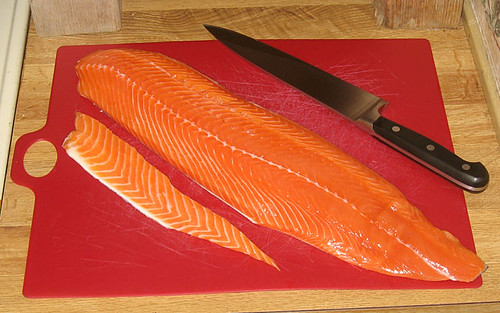
Try to trim the filet so the two ends are nearly symmetrical. You'll see why later.
Step 3: If you bought a single filet, cut it in half as precisely as you can.
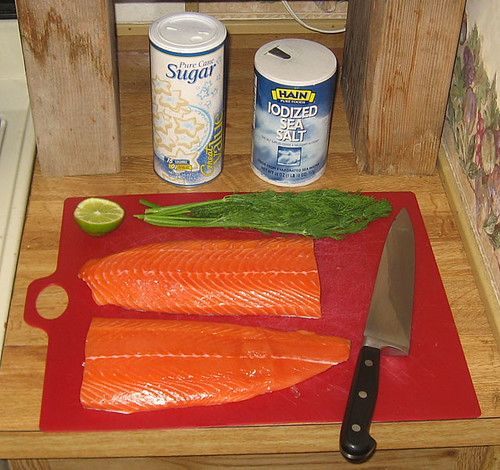
As if using white sugar wasn't evil enough, I bought it at Wal-Mart. Then I ate a baby.
Step 4: Place a layer of plastic wrap on top of the plate (or the plastic tray, if you saved it) that you’ll be curing the gravlax on. Then put the salmon filets on the tray. If you skip this step, you will make a big mess.
Step 5: Shake the salt and sugar over the thick parts of the filet. Don’t try to go all the way to the edge: it’ll soak through as it cures. Use more salt and sugar on the thick end of the filets, and less on the thin end.
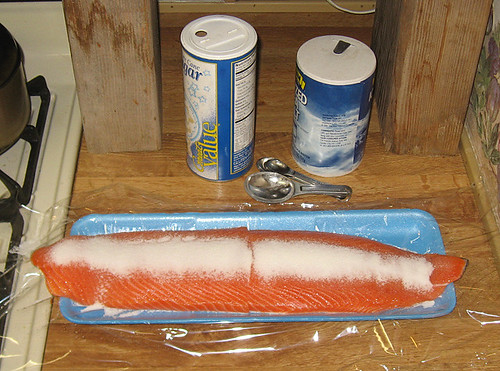
Just shake the salt and sugar right out of the measuring spoons.
Step 6: Mince the dill. Most recipes tell you to leave it whole, but you can use a lot less if you mince it—and I think gravlax tastes better with a few dill bits left on it.
Step 7: Distribute the dill over the filets.
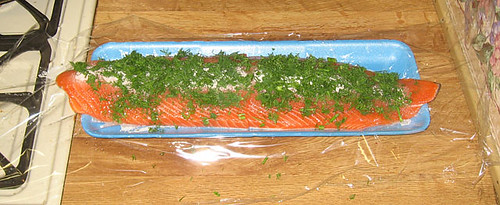
Looks festive, doesn't it?
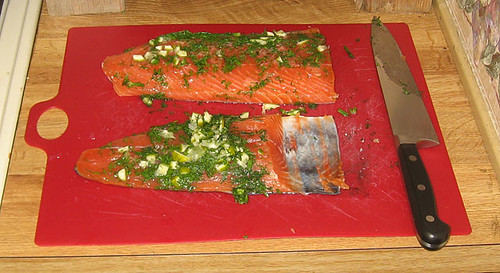
Step 8: Cut three thin lime slices. Dice the slices and put them on top of only one of the two filets. (You’ll understand why in a moment.) Use slightly less lime than I used in the picture: this is a bit too much. It is important that the lime bits don’t touch the fish, or they’ll make little white acid burns. This is why you can’t use lime juice.
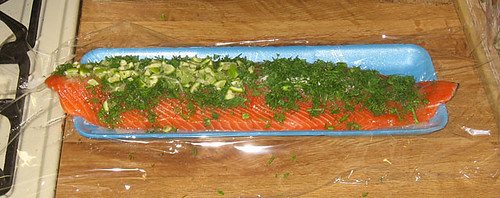
Strictly speaking, the lime isn't traditional...but it tastes much better.
Do you have a zester? If so, instead of dicing lime slices, I recommend that you zest about half a lime and mix the zest in with the dill. Then you don’t have to move the dill back and forth or carefully distribute pieces of lime: you can simply pile the mixture all on one filet and skip to step 10. (Thanks to commenter Gail for the tip.)
If the table calls for 3 lime slices, zest about 1/2 lime. 6 lime slices = zest an entire lime. In between? Average it out.
If you don’t have a zester, or don’t know what a zester is, don’t worry…this is just a time-saver for people with lots of kitchen gadgets.
Step 9: Take the dill off of the other filet and put it on top of the filet with the limes. Remember, you need to keep the lime bits from touching the fish.
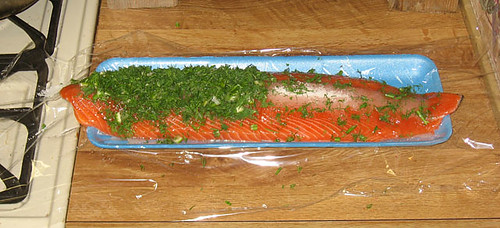
You'll understand in a moment why I do things this way.
Step 10: Make a big salmon sandwich by putting one filet on top of the other. This is why you put most of the ingredients on one filet: if you try to tip one filet onto the other while it’s covered in dill and lime bits, you’ll make a huge mess.
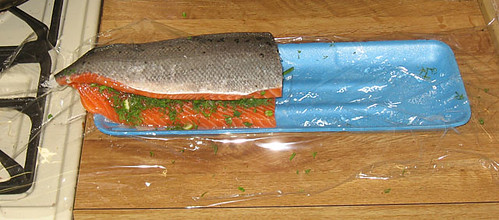
We're almost ready!
Step 11: Wrap the filets as tightly as you can in the layer of plastic wrap you put under them.
Step 12: Wrap the filets in at least two more layers of plastic: one around, one lengthwise. Wrap as tightly as you can: you want the filets to be touching each other at all points, with no air space. The easiest way is to lay a few big sheets of plastic wrap out on the table and roll them up.
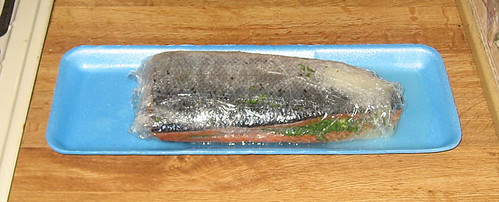
This photo was actually taken after curing, but it looks the same.
Step 13: Put the filets in the refrigerator. Make sure they’re on the tray or plate, because they’ll leak no matter how well you’ve wrapped them.
Step 14: Traditional recipes tell you to put a weight on top of the filets while they’re curing, and to remove and re-baste them during the cure. This isn’t necessary if you’ve wrapped them tightly…but you do need to turn them over a couple times. I flip mine morning and evening.
Step 15: This is the hardest part: wait two days. (Again, I recommend turning the package over twice a day.)
Unlike most recipes, curing time doesn’t need to be exact…it’s OK (though not perfect) after 36 hours, and I’ve left it to cure over three days and it tasted the same.
Intermission
And now, the delicious part!
Scrape the dill and lime debris off the top, and slice the gravlax as thinly as you can. For best results, slice diagonally so that you get the largest slices possible.
Just slice...
If you’re feeling frisky, you can present it nicely: it’s traditional to serve gravlax with a dill and mustard sauce (non-Facebook link) on crisp bread, often topped with a squeeze of lemon, a few capers, and some white pepper. (Another delicious suggestion involves lemon zest, orange zest, and juniper berries.) But as I am a bachelor and eat a paleo diet, I usually just stand over the cutting board and pop the slices straight in my mouth.
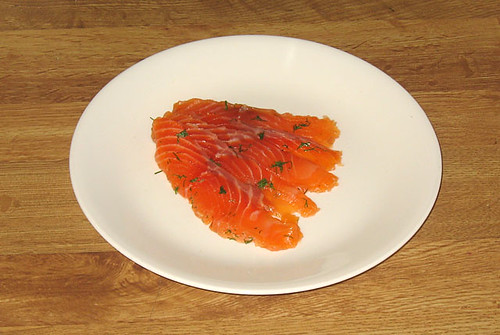
...and serve! This will last me approximately eighteen seconds.
It’s probably good that salmon is expensive, or I’d be eating gravlax every day!
Live in freedom, live in beauty.
J. Stanton
- Feel free to explore gnolls.org: the index is a great place to start.
- If you’ve found that my recipe is indeed the best on the Internet, you can support my efforts to keep gnolls.org ad-free by buying a copy of my “Raw, powerful and brilliant,” “Insightful and surprisingly heartfelt,” “Funny, provocative, entertaining, fun, insightful,” “Totally engaging” novel, The Gnoll Credo. Buy it from Amazon.com, directly from 100 Watt Press (signed, at no extra cost), and worldwide.


I will try this recipe if it’s the last thing I do. OK, probably much sooner than the last thing I do. Like, maybe this weekend?
I’ll report back with results!
I must say, this is the most unusual recipe I’ve seen in awhile. However, I’m going to try it!
JS,
Thanks for this recipe! Looks amazing. I also enjoy slicing my freshly finished dish and popping it straight into my mouth. Why dirty a dish? 😉
Plastic wrap! Uh! The devil!!!
Seriously, what about wax paper, like in the good old days?
Namu:
Excellent! Let me know how it turns out for you. It's fun to have a recipe where it's impossible to burn or undercook anything.
Caveman:
Cured meat has a long history. I suspect meat has been preserved with brine for a long, long time…especially in cold climates like Northern Europe.
Chris:
Why indeed? And if you're sneaking my half-and-half out of the refrigerator, you shouldn't complain when it's got my germs on the spout.
Franco:
I don't know…I've never tried it. I suspect you'd need some tape in order to keep the bundle tight. Try it and let me know what you find out!
JS
When I make gravlax (or in Swedish “gravar laxen” in present tense) I do not use either suger or lime but salt, white and black pepper, dill, that I do not mince, and put it in the fridge for at least 24h.
Björn:
How much salt do you use per weight of fish? I'd love to be able to tell people how to make it without sugar. (Credit to you, of course.)
I'm biased towards the salt/sugar because I eat it naked, and the salt gets overwhelming when I sock down half a pound or more…but if I were eating it more traditionally and in smaller quantities, on crisp bread or toast, I'm sure I'd like the salty/peppery version, too.
JS
Growing up on what now they’ve now labeled “The World’s Greatest Salmon River”, I’ve had my fill of the beasties, pretty much all we ate some months.
Also a great fan of sashimi so I know they freeze the salmon before preparing it, in order to kill the tapeworms that salmon often carry… I’m wondering if this method would do the same. Not a big fan of fish tapeworm myself. If the salting is done right, likely.
And remember, farmed salmon is killing the wild stocks, likely doesn’t have the same nutritional content (certainly doesn’t taste right to me), so don’t buy it.
yes, it is recomended to freeze the salmon in advance. Regarding the salt don’t have a specific measure for it, just a feeling. I use sea salt that I crumble over the salmon so the whole of it covered. I try to use as little as possible and still cover the whole side of the filet.
Having tried your Gravlax I stoked to give this a try, thanks!
This looks delicious. I’m trying this as soon as I’ve got some fresh salmon in the house!
Björn:
Do let me know if you ever decide to measure it…for instance, by shaking the salt out of a measuring spoon and counting how much you used.
HeMan:
That's a good question about the tapeworms. I know the cure kills a lot of fermentation, as I've made gravlax from salmon that was starting to get a bit whiffy (hey, it was 50% off!) and it came out fine.
Most of my experimentation was trying to figure out how little salt/sugar I could use and still actually cure the fish. Not enough, and it's still raw and mushy: too much and it's hard and crusty. When it's just right the fish firms up and is much easier to slice thinly.
Keep in mind that typical home freezer temperatures aren't supposed to be low enough to kill parasites: -4 degrees F for 7 days is considered a minimum (source). Dry salting is considered to kill all parasites, but the recommendation is for 5-7 days.
Of course these are government recommendations, which err on the side of paranoia. Personally I don't worry about it: most parasites are visible, and are much more of a concern with restaurant-prepared fish than with fish I'm preparing (and closely inspecting) myself.
Jeff:
Go for it! It's remarkably simple.
Katie:
Let me know how it works for you! It makes me want to start a herb garden so I have a reliable supply of fresh dill.
JS
After reading your article I did a quick check in my Swedish cookbook collection and found a number of recepies for “Gravad Lax” or cured salmon. Some are more than a 100 years old. Gravad = sugarsalted. If you remove the sugar it’s salted.
It’s fairly evenly spread between more sugar than salt, more salt than sugar and the same amount of both. More sugar than salt makes it a little milder.
I think that the amounts is not that important as long as the mix cover the whole side of the salmon.
2 kg Salmon cut in 2 equally large pcs
150-200 grams of salt
150-200 grams sugar
Mix sugar and salt and rubb part of the mix on all 4 sides. Then put one side on a plate with meatside up and cover it with the rest of the mixture.
10-20 crushed whitepeppercorns sprinkled over.
1 cup of dill coarsley cut, on top of that.
Your Step 10-15.
For me lime comes later when you eat the salmon, but it’s always fun to experiment.
SR
I love gravlax. It’s a must during Christmas time ever since I was a child growing up in Sweden. I make my own too..Yummy, now I have to and get some salmon..
This sounds great!
I will have to make some this weekend.
Think I will cold smoke some after the cure and see how that turns out.
Sten:
Thanks for digging that up! White pepper is definitely a good addition if you use 1:1 salt:sugar. I think the lime goes best with the sweeter mixtures, and the pepper goes best with the saltier mixtures.
You're reminding me that I should offer the recipe in metric units, too. Fortunately a teaspoon is basically 5ml.
Jo:
Glad I could remind you. Enjoy!
Johnnyv:
Make sure to try some unsmoked, too…and let me know how the smoked stuff turns out!
JS
I’ve made gravlax many times with more salt and sugar than this and quite successfully too judging by how much people seem to enjoy it. That said, reducing the salt to a minimum without compromising the results can only be a good thing. I bought some salmon this morning to make gravlax for Mother’s Day and I will try these proportions.
I’m a bit surprised there is no mention of alcohol in this discussion. I usually add a TBS or two of vodka (or sometimes tequila or whatever). I know that in Scandinavia aquavit (sp?) might be used. Is that typical/traditional?
Jock
I have hot smoked cured salmon before but without the dill. I find that the hot smoked dill has an unpleasant taste. Don’t know if the same would apply to cold smoked.
Jock
Jock:
Most of the recipes I see use much more salt and sugar, and then depend on stopping the cure at the right time. I came up with this one because I don't want to have to worry about how long I cure or how thick the fish is. Just throw it in the fridge, turn it a few times, and pull it out anytime after two days.
Let me know how it works for you! I'm open to changes and refinements.
JS
And, a note to everyone: it's not nearly as good without the lime. I made a batch without and added the lime afterwards, and it's just not the same.
[…] I love Gravlax. I don’t know if Chris was aware of that fact when he shared this excellent post with me on how to make it yourself at home. […]
So, I made this for a Mother’s Day brunch and it was excellent! The reduced salt and sugar let the flavor of the fish shine through and the texture was buttery. This is my new go to gravlax preparation. Thank you
Jock:
Thanks for reporting back! I'm glad your brunch was a success.
It took several attempts to get the ratios just right. Any less salt/sugar and it's floppy and raw-tasting, much more and it gets that hard salt-lick taste and texture…especially on the outside.
For an extra taste spiff, try pretending it's sashimi and dipping a corner in soy sauce (gluten-free, of course), perhaps with a bit of wasabi.
JS
I have made this a number of times now, I use xylitol instead of sugar at 50% as it is twice as sweet. I like it a bit more salty so I increased the salt/xylitol combo by 50% the second time and it came out perfect to my taste.
I make it by placing lime slices in a vacuum bag the salmon skin side down on top of limes, then the salt sugar mix and finally the dill on top. I then vacuum and seal the bag. This way requires no trimming and the lime doesn’t discolour the flesh.
Cold smoking gives fantastic results, I used grapefruit wood and smoke for eight hours then wrap and refrigerate overnight.
The unsmoked stuff goes great in som tam(Thai green papaya salad).
Johnnyv:
The vacuum bag is a great idea if you've got one, as is putting the limes underneath. Do you use more lime than the recipe calls for along with more salt/xylitol?
Thanks for the report! It's good to know that there's a fully sugar-free option for the zero-carbers, and the cold-smoked version has to be interesting. I've linked your comment from the recipe.
Xylitol tastes a bit minty, doesn't it? How does it change the taste?
JS
I double the lime as well, but I love lime.
Xylitol is fine in this dish in my opinion it’s cooling effect isn’t really noticable.
I wouldn’t use it to make panna cotta though.
[…] Awesome Gravlax at Gnolls […]
Gravlax…my new candy.
I used Sockeye, which I’m usually not a fan of, but, I must say was great. Regular Ocean salmon wasn’t available at Costo (it was farm raised), the Sockeye was Ocean caught.
Any-hoo, it turned out wonderful. It had a little burn, only because some the Lime pieces were a little thick, my fault. Next time, I’m trying lemon and will let you know how it goes.
Thanks again.
This website is by far one of the best Paleo blogs out there. It really gives good ammo to use on the indoctrinated and I like your writing style. Can’t wait to read your book.
Carl
P.S. – I was thinking about vacuum sealing, but wasn’t sure if it would hinder the process, in that it wouldn’t let the excess juices run out.
Carl:
I'm glad my recipe works for you! The nice thing is that the cure overwhelms much of the taste of the fish…so if it's gone a bit whiffy (or if you don't like sockeye) you can still cure it and it'll taste fine.
As far as the lime pieces, I slice them absolutely as thinly as I can. Keep us posted on the lemon.
JS
So, I made it. I let it cure for 3 days. Came out buttery smooth. I’ve got to tell you though, I’m not used to eating raw fish. I keep waiting to keel over or something.
Do you just keep the uneaten portion under wrap in the fridge?
Dave RN:
I'm glad it came out well for you!
This cure won't stand up to room temperature (which is why cured bacon and ham use nitrates in addition to salt and sugar), but it's fine in the refrigerator.
And yes, I just keep the uneaten part wrapped. Leftover containers work too. Anything airtight is fine.
JS
(Note: this is my opinion, and you eat any raw/cured fish at your own risk. I'm sure the USDA says you should always cook it to eleventy-million degrees.)
I keep meaning to try this. I love gravad lax. My fridge has a good space now and I'm out for most of the weekend (eating-wise), so I can donate the real estate and the time to doing this. We have pre-made gravad lax quite often, but making my own will be really cool! I'll use crushed sea salt, though. I keep in a couple of “gourmet” sea salts, Maldon and Halen Môn.
I've been to Sweden a few times . Dropping downstairs in the Hötorget in Stockholm and seeing buckets of crayfish ready for eating and slabs of salmon (lax) being sliced with such precision is a real treat. Swedes have such a cool diet; shame they're so hooked on the US for lifestyle aspirations. They'll lose it … and once it's gone, it will be gone.
Glad to hear it…and gourmet sea salt is an excellent addition. Let me know what you think once you're done!
I've found that I can use about half dextrose and half table sugar without changing the taste, if I up the total amount very slightly. This will lessen the fructose load if you're concerned about that. (100% dextrose isn't as good.)
If you're used to genuine Swedish gravad lax, you might want it a bit saltier. But I recommend starting with this basic recipe and modifying it to taste.
I've also found that if the filet is so dry that the sugar and salt aren't dissolving, just a few drops of water will fix that.
JS
How long do you think this stuff would last in the fridge? I made a batch but promptly forgot I made it… it’s been two weeks, so I’ve tossed it.
But for future reference… I’m thinking a week max. But I’d love to hear some opinions.
Shane:
I've served gravlax that was a week old (a week since the cure was over, not since the cure started) and was fine.
That being said, I go by smell. If it smells funny, don't eat it, and if it tastes funny, don't eat any more. Salmon has a very distinct odor when it starts to go bad.
JS
I was scared to open the bag after two weeks. Next time I’ll be a bit braver. I need to find more ways to eat fish – can’t do sushi all the time.
Shane:
Once you taste it, I guarantee you won't ever forget about it for two weeks again! Usually I have to restrain myself from digging in before the cure is finished…
JS
[…] [Best Gravlax recipe on the Internet] […]
Can you use Atlantic (farm Raised)salmon and if not what would you suggest?
Andy:
You can use any kind of salmon. Wild is better, but the recipe works the same for all kinds.
JS
Just an FYI about storage, if you leave it covered in the fridge, the curing process isn’t actually stopped, so if you aren’t going to eat the whole thing within a day or two, I would freeze the rest. This stops the curing process.
If you like gravlax, you should try “sursild”, pickled herring. Another nordic traditional dish, and can be varied indefinitely. It’s a little more tricky to make than gravlax, but oh so tasty, especially around christmas when we Scandinavians need an injection of vitamin D, since we haven’t seen the sun in so long.
Read this post start to finish, thank you for the recipe, I’m trying for the first time this week. I’ve smoked salmon with excellent results and never worry about parasites. But just for clarification, you buy a filet of salmon at the locale Costco or meat counter, cure it for 3 days with this recipe, and serve it right away? A few other recipes on the web suggest freezing for 7 days afterward. I’m not afraid I have no problem eating raw hamburger on occasion, but I’ll be serving to friends and family, don’t want anyone mad at me.
Inga:
The reason my recipe works so well is because the curing process does indeed stop, due to all the salt and sugar being absorbed. Regular recipes depend on stopping the cure at the right time, because they add way too much sugar and salt. I've verified this by leaving the fish wrapped and “curing” for a week before eating it…it tasted the same.
I'll have to look into sursild…unfortunately I don't think I can get herring where I live!
Larry:
That's what I've always done — and neither I nor any of the people I've served it to (nor any of my commenters) have ever had a problem. But like I've said, there's probably some government advisory against it, and you eat it at your own risk.
JS
I have made gravad-lax for many years but I have never thought of smoking it before I will post the results of my current cure which is in the fridge now as soon as one half has been smoked and tasted by an “independent” panel.
Hmmm … I like the sandwiching technique, and the lime and mincing the dill … but I think when I try this I will stick with the recipes that completely coat the exposed flesh with the salt/sugar mixture, and weight it down. Maybe you have to be careful about overcuring … but I love the uniform deep red looks of that technique.
Thanks for posting this recipe!!
Es:
The reason I only pile the salt/sugar in the center is because it diffuses slowly throughout the meat as the cure progresses. When I distribute it evenly over the surface, the (thinner) edges become hard and crusty while the (thicker) center is still soft and raw.
Salt/sugar amount and ratios are a judgment call. I wouldn’t use any less in total, as the meat won’t completely cure…but you can certainly add more salt, sugar, or both. Lots of people like the more traditional recipe with 1/2 salt and 1/2 sugar, and some people like a harder cure with more total salt+sugar.
Let me know what you find out! I’m always interested to hear how this recipe works for my readers, and what variations they've been successful with.
JS
[…] chicken- amazing!)Garlic Dill Pickles at Keeper of the HomeHomemade Yogurt at Keeper of the HomeAwesome Gravlax at GnollsButternut Squash Chips at Health, Home and HappinessChicken Pepper Poppers at Health, Home […]
Thanks for the recipe. I zested half a lime & mixed that with the dill (& added a bit of fresh parsley too). I think it worked out well, got some nice flavor without having to worry about the acid burns. You may want to give it a try. It eliminated having to spread the dill over both pieces, I just piled the dill/lime zest/parsley mix on one.
Gail:
Zesting is a good idea. I don't mandate it because most people don't have a zester and zesting with a knife is a bit tricky…but I bet it tasted great! Perhaps I'll add a note to that effect.
JS
Before reading this recipe I made gravlax using the 50/50 salt/sugar recipe and was pretty liberal with the amounts. It turned out great but the surface was burnt by the salt, so looking forward to trying this. I fish for salmon in Scotland and many visiting anglers from Scandinavia gravlax their catch. The worm thing is a worry but it doesnt seem to stop folk gravlaxing fresh wild salmon. I read up on this and farmed salmon are not a risk in this regard according to government advice.
An earlier writer above tried to persuade people not to buy farmed salmon because its not as good as wild. I agree however farmed salmon plays an important role in taking pressure off wild salmon which itself is an unsustainable resource which should not be harvested for commercial reasons. For more info visit the North Atlantic Salmon Fund website.
Sean:
You're correct. The trouble is that with seven billion people in the world, everything is unsustainable.
Let me know how the recipe works for you!
JS
Tried your recipe a couple of times. I like the sugar salt proportions very much. I also liked the time factor. Other recipes call for it to cure longer. I did substitute the limes with a spinkling of Absolute. Wraping it in plastic wrap and then Vacu sealing it in a food saver eliminates the turning and of course it doesn’t leak. The cure is pressed in with a nice equal pressure. Next time I am going to try the limes.
Good call on the Absolut!
I've used Akvavit before which itself is often infused with dill, caraway and fennel. The Swedes get a little shy about Akvavit, although they have some excellent varieties. The Danes seem more proud, but it's all Scandinavian … fish, cured with something or other and then human cured with schnapps 😀
Bill:
I'm glad it works for you! Vacuum sealing would indeed save some time and effort.
Paul:
I've had some gravlax that used fresh juniper berries in addition to the lime. It was delicious!
And yes, I think every European country that has salmon, an ocean, and cold weather has its own variant of gravlax.
JS
I may have told this story, but one of the most memorable experiences I hold dear is walking downstairs into the indoor part of the Hötorget (Hay Market) in Stockholm to be met by an almost endless set of stalls selling gravad lax and crayfish.
Nothing like a bag of crayfish, exit the market, eat like a tramp under a statue of Neptune, burp, wipe face, chuck bag of shells in the bin and then tuck into a few slices of cured salmon while walking through to Gamla Stan and the Ardbeg Rooms for a good local pint (with greasy salmon fingers) and slug of something Scotch! Damn it! I love Stockholm.
You know what, J? I've still to make up your recipe. I'll grab some good salmon soon and do this.
A variation that I have used for several years, courtesy of New York Times Sunday Magazine, is to add about a tablespoon of ground dried juniper berries as well as ground black pepper corns. A splash of gin on the cut slices adds a bit of extra flavor. Always a hit at holiday parties.
Cody:
That sounds properly festive! I find it pays to be cautious with the juniper berries, though.
JS
I just tried your recipe using a 1 lb 1 oz size filet and follow your recipe. 51 hrs later I removed the various ingredients ( dill, lime zest, cracked pepper, salt sugar)–it was a disaster! The “gravlax” was only slightly less raw than before the curing. I had my doubts about curing with using only 2 1/2 tsp of salt but I decided to go along with your calibrations and followed everything else exactly as you recommended. I did mix the dill and lime zest together and mixed them into the dry mix (salt & sugar) even added about 1 TBS of vodka.
I have made gravlax many times before using 1/2 cup kosher salt; 1/4 cup sugar; lemon, lime and orange zests; 1/4 cup chopped dill; 3 TBS of vodka and wrapping in 2 layers of plastic wrap and topping with a plastic wrapped brick. I did not make a sandwich but rather wrapped the whole filet in plastic to ensure the liquid would drain out into a large sized baking tray (able to fit into refrigerator). No acid burning marks or other problems with the filet.
Am really disappointed and sorry this effort did not work out. Am going to try again later this week and will revert to my time tested recipe.
It is not my recipe so I must give credit to Emeril Lagasse when he hosted “Essence of Emeril”on the TV Food Network many years ago.
N. Lebo:
I'm sorry it didn't work for you! You're the first to report a problem, so let me ask a question.
You said: “I did not make a sandwich but rather wrapped the whole filet in plastic to ensure the liquid would drain out into a large sized baking tray (able to fit into refrigerator).” Does that refer to your usual recipe, or did you use that technique for this one?
Because that would explain the problem: if you let the liquid drain out, it'll take the salt and sugar with it — and you'll end up with mostly-raw fish.
Whatever wrapping technique you use, you'll want to make sure it's as water-tight as possible (although there will almost always be a little bit of leakage unless you have a vacuum sealer). That's why I specify wrapping three times as tightly as you can. Furthermore, if you only have one filet (i.e. you don't have enough fish to make a sandwich), it's absolutely critical to flip it at least every 12 hours, more often if possible — because the salt/sugar liquid will tend to sit on the bottom of the package, where it won't cure the fish.
There is also the possibility that you simply like a much harder, saltier cure: 1/2 cup of salt and 1/4 cup of sugar will result in some VERY hard gravlax. That's not how I like mine, but I won't dissuade anyone else from making theirs however they like it best.
JS
I was referring to my “original” recipe. I followed your recipe for the most part; wrapping the sandwich filet in three layers of plastic wrap as tightly as possible. I did, however, place a brick (in plastic wrap) on top and flipped the salmon every 12 hours. I used fine Kosher salt instead of sea salt.
I plan on doing another gravlax this coming weekend–using your recipe and another using my “original” and will compare the results. Will let you know. I am “psyched” to get your recipe to succeed for me!
JS, thanks for your feedback.
N. Lebo:
In that case, I suspect that you may simply prefer a harder cure. Feel free to use this technique with more salt and/or sugar. Also, if two days pass and the fish is still too soft for your tastes, you can always add more salt/sugar, rewrap it, and cure it another two days! It lasts me about a week in the fridge if the fish was fresh to start with, so you'll still have a few days to eat it.
Some people do like harder, saltier gravlax — particularly if they're serving it traditionally, on crisp bread with dill sauce, at which point it's more of a condiment for the bread than a main dish. However, since I'm eating it by itself, as a meal, I prefer it to be both softer and less salty…I couldn't eat over a pound of it otherwise!
Something that helps the cure distribute more evenly is to put much more of it on the thick parts of the filets. As I said to Es above, “The reason I only pile the salt/sugar in the center is because it diffuses slowly throughout the meat as the cure progresses. When I distribute it evenly over the surface, the (thinner) edges become hard and crusty while the (thicker) center is still soft and raw.” Did you find that the edges were OK but the center was raw, or did you find the whole thing too raw for your taste?
JS
50 /50 Sea salt and Brown sugar ratio. Fresh dill is always a yummy inclusion.
24hr. curing time.
Foil-wrap fish on deepish-platter (to catch the liquid):
Weight: I use light-rocks to evenly press the fish down.
Refrigerate.
Flip at 12 hrs.
Re-Rock weight.
At 24 hrs. rinse and serve as you wish.
I love to get fresh baguette, generously schmeered with cream cheese, sprinkle with ridiculously thin slivers of lemon including rind, some more fresh dill and a blast of cracked black pepper. VOILA! Gone Yummy.
JS,
I just completed a 2nd attempt–this time using 3/4 cup fine kosher salt; 1/2 cup sugar lemon, lime zests; 4 grinds of freshly ground pepper; 1 and 1/2 TBS of lemon flavored vodka and followed your instructions. I used a brick and flipped the “sandwich” every 12 hrs and allowed the salmon to cure for approximately 38 hrs.
The gravlax is super! Not hard or crusty but soft and “buttery”. The filets were rinsed in cold water and the initial tasting found the gravlax to impart a mild saltiness.
I am very pleased and delighted with the outcome.
Am planning to serve it as an appetizer with garnishes (capers, chopped red onions, thinly sliced lemon) as part of the Passover seder.
Happy Passover and Happy Easter!
Zenia:
Cream cheese is delicious. Another variation is to pretend it's sushi and dip it in a little bit of tamari + wasabi.
N. Lebo:
I'm glad to hear of your success! May I ask the approximate weight of the fish you used with the 3/4 cup salt and the 1/2 cup sugar?
L'Chaim!
JS
Ok, today is “D” Day. My 2 lb Salmon has been thawing in the fridge, and now I am ready to rock and roll.
I spent hours reviewing the internet. I was lucky to come across your site. In my experience, it seems the best ideas are simple.
I read all the information you provided, including the comments,
top to bottom several times.
I even have a Zester tool in my Camp Kitchen drawer, didn’t even
know what the heck it was…till now.
I am going to follow your method to the “T”
May as well use my Vacuum Sealer, while I am at it.
Will let you know the outcome in about 36 hours.
Thanks for your intuitive information!
Danny
Danny:
36 hours is doable, but 48 hours is recommended for best results.
I hope it works for you…I just served it to a bunch of people this weekend, with excellent results. Even the teenagers loved it!
JS
Howdy here from Texas.
Just to be on the safe side, I waited 3 days-about 72 hours.
Since I did 2Lbs 1oz of Salmon I used the 2.25 ingredient conversion table, and zested 3/4 lime…for weight of the Salmon.
Since you mentioned the fresh Dill amount did not have to be precise, I had 3/4 oz on hand, minced stems and all.
My wife bought 2 fillets, one I hot smoked with my special recipe. When I went to grab the second one later, it happen to be skinless Chile Farm raised. Darn It! Decided to proceed anyways.
In the final step, I vacuumed sealed the sandwich. Most likely I did not need to turn them every 12 hours, I did anyways, just in case gravity had an effect.
After all this work (actually it was fun) I was anxious on the
results.
I went head and drained off the juices, scraped off the most of the Dill, went ahead and rinsed, patted dry with paper towels (it was easier to remove some more of the dill, still leaving some flakes for presence).
Results….Man was I surprised! The texture, flavor (had a nice
Dill flavor presence also) awesome.
Along with the cutting samples…(Sushi), we ate it traditionally with my home made Bagels, Red onion (purple color), and cream cheese. My friend who dislikes Sushi,(so he tells me)helped himself to a second sandwich.
Next time I will make sure the skin is on the fillet, and hope to get Wild Salmon. If you have any other suggestions, I am open, other than that we are very pleased. Thank you for all your experiments. Been there with many recipes.
Chow.
Danny:
I'm glad you and your family enjoyed it! (Even teenagers and people who “don't like raw fish” usually do.) One of the reasons this recipe works so well is that curing time isn't critical: as you discovered, it's fine to leave it for three days instead of two.
My only refinement (which I've added to the recipe) is to use more salt and sugar on the thick end of the filet, and less on the thin end, for a more even cure. Other than that, you can experiment with adding more salt or sugar to taste: some people like their gravlax saltier. I wouldn't use less salt or sugar, though, as the fish probably won't cure completely.
Enjoy your gravlax…and if you have any favorite recipes you'd like to share, please do!
JS
Thank you for sharing this detailed set of instructions for making gravlax. I made it last week, and it was awesome! I was pleasantly surprised because I fall into the kitchen klutz category.
Erica:
Most of being a “kitchen klutz” is not knowing all the tips, tricks, and details of cooking that most recipes simply assume you're already familiar with. I decided to take the guesswork out by illustrating each step.
I'm glad it worked for you!
JS
The great thing about paleo/predator eating in general is, you simply cook some meat your want to eat with some veggies that you want to eat. Flounce up to your heart's content thereafter.
With this gravadlax recipe, it is a process, it does take time and it does require care, but it is a method which is relatively easy to follow and does not require precise timing. Remember, this is a method which was used by Scandinavians with much less kitchen equipment than any of us can really comprehend to quite simply preserve a glut of fish.
I just made a batch using your recipe, but the salmon’s been frozen for the last week and I didn’t completely thaw them before seasoning and wrapping the pieces. is that a problem and is there a way to fix that?
I doubt it – the “cooking” effect of the salt will still have got right in there. It will have thawed through the process and the excess water fully released. Perhaps lay some weights on top of the fish? Place a tray on top and something heavy to press out any potential excess water.
E. Reich:
Just let it cure an extra day or so to make sure it's completely thawed. It'll be fine.
(That won't work with most recipes, but it'll work fine with this one!)
JS
[…] in the cure. I checked online as well. Reading some great recipes online in places like http://www.gnolls.org/1887/the-best-gravlax-recipe-on-the-internet/ or http://www.delish.com/food/family-meals/homemade-gravlax-recipe or […]
Hi,
Gravlax is my all time favourite starter, by Dad is a chef and used to do it for me all the time! The bit that made his incredible was he used to do a mackeral pate/paste with it. Blitzed mackeral, with a bit of horseradish, lemon, salt pepper and splash or worcester sauce. Try it, it completes the dish for me! Doing this for a dinner party next week, doing a “come dine with me” with friends! Wish me luck!
Pete:
I'm sure it'll be delicious! If you're serving it the traditional way (on toast, with a pungent sauce), you can add some more salt to the cure to give it a more traditional taste.
JS
How did it turn out, Pete? Good? I hope so.
The great thing about this process is, really delicate fish can be cured; likewise, strong flavours can be amplified. It's a simple, but good process.
New house, now, bigger fridge … time to make another one.
Finally got around to using lemons and it tasted about the same as it did with the limes…and just as delicious.
I only use sockeye and it comes out great every time.
Does anybody else have a slight taste of tea in their gravlax?
Carl:
Perhaps the lemon makes it taste more tea-like? Or perhaps it's something about the fish…wild fish varies in taste much more than farmed fish.
JS
Now that much of the fresh salmon sold is farm raised, and colored, and not as firm, I follow your excellent recipe but use a wooden board (cedar) and a five pound flat brick, put that on top of the gravlax in the fridge and it presses the moisture out. I take the fish out when it does not leak anymore.. 2, sometimes 4 days.
Hi,
I am a keen fly fisherman from the UK, I tend to go to places with larger rainbow trout (6-30 lbs). My biggest problem has always been what to do with the fish I catch, now I have the perfect answer.
I made 2kg (4 sides) using your recipe and it came out fantastically well. I am now fighting off the friends and family for the next batch!
Also freezing the fish and then fully thawing them prior to starting the curing process seems to work better than starting the curing process on fresh “just caught” fish.
Many thanks
AnthonyC
I love making Gravlax..and have used this recipe now exclusively…many of my Lox liking friends are impressed…I do add liquid smoke that i purchase on line just becuz i can get it without preservatives. I do find zesting the lime a better choice…I feeding a hungry after church crowd,who are salivating every time i put it out. I wait for the sales,buy and freeze and prep as needed…great recipe
HobbyHorseman:
I’m glad it works for you! You’re correct that farmed salmon can be somewhat “mushy”…I try to avoid that stuff, but you’ve got a good workaround.
AnthonyC:
Trout has a similar texture to salmon…I may have to try your suggestion sometime. Re: the freezing, perhaps it allows the salt and sugar to diffuse more quickly?
It’s uncanny how people who “don’t really like fish” all seem to enjoy gravlax!
Frederick:
Smoked salmon is delicious too, so I can believe that adding liquid smoke is a good flavor. Thanks for sharing your experience!
JS
Thanks so much, I just finished preparing. Now the hard part, 2 days. I’m sure it’s going to be excellent.
Morgan:
How did it turn out for you? Let us know!
JS
Thanks for the recipe and especially the conversion table which was very helpful. And yes, the hardest part was waiting 2 days!
Sonia:
You're welcome. It's rare that I want to cook the exact amount specified by a recipe, so I figured I'd include the table so people can make as much or as little as they want without having to break out the calculator.
JS
My friend’s husband is a well-known gerontologist, who eats 4 oz of home-cured “lox” every evening. and thinks it’s great for one’s health.
His wif recently showed me how to make it, and my husband and I “pig-out”, using 2 pounds of salmon in 2-3 days.
I have always loved gravlax, and now plan to use your recipe in the next day or two. Wish me luck!
My only concern is eating too much salt.
i am prepared to make gravlax today and was just checking out some other recipes for a point of reference and found yours. I think I will try it!
I bought two kinds of fish, one fresh Keta salmon and one previously frozen “regular” salmon (wild caught, but I forgot which kind).
I saw these questions asked, but did not see clear answers:
How will adding Vodka/Gin affect the cure? Or will it, is it just for flavor?
How long can I keep the fish once the cure is finished? I am serving it for Thanksgiving, in 9 days, I hope it’s not too early.
June:
Let me know how it turns out! There isn't a lot of salt in my recipe: one tablespoon in 1.7 pounds of salmon, of which some ends up dripping out as liquid.
wendy:
Adding alcohol won't do anything bad to the cure…I don't like the taste myself, but some people swear by it.
Nine days is a bit dicey…given two days to cure, seven days is right at the limit of how long it'll keep, in my experience. I would get fresh fish closer to Thanksgiving.
JS
I must say I will not be using this recipe. It has far too little salt to actually cure the fish (and don’t use iodised salt, it is terrible for meat). I assume he is using such a small amount as with anymore it is too salty. The reason for this is this recipe uses rock salt. Depending on the type of salt depends on it’s ability to remove water from the meat. The best salt to use is Morton’s Kosher salt. It is less salty and absorbs liquid perfectly.
When I make gravlax I completely cover the fish with the kosher salt (my quantities are secret though sorry)use more sugar and actually add some ground mace for a fantastic nutty flavour. I usually turn this into Lox though by cold smoking it in alder wood or apple/maple wood.
Look around as this is not the internets best recipe.
I mix the salt sugar and dill with 20 mls of bombay sapphire gin and spread still using the lime fantastic
OakmanNZ:
My claim is “best recipe on the Internet,” not “best recipe that's kept as a secret in someone's head”.
Also, kosher salt only “draws water out of the meat” if you're removing it after the cure. That's not how my recipe works: I dry the salmon before curing, and all the salt and sugar ends up in the meat — not scraped off later.
david:
Some people add juniper berries, which are the main flavoring in gin, to their gravlax…so I'm sure it tastes great with the gin!
JS
Really….kind of a useless comment to say how you have a much better way of doing things but aren’t going to share it. 🙁 I just put a batch in the fridge, added a tablespoon or so of gin this time. I think that will be really nice.
I used your sugar/salt ratios and it worked out really well.
I did tweak the flavourings, though: I used fennel tips, dill, lemon zest, coarsely crushed juniper and Hendricks gin.
I thought it was outstanding (the best gravlax that I’ve had so far), and a big part of that was the texture and the salt/sugar taste.
My only problem is that one side tastes better than the other – and I don’t know if it was the ‘fennel tip’ side, or the ‘dill side’. Guess I’ll just have to make some more to find out!
Gail:
People are reporting success with the gin, so I'm sure it'll be delicious.
Breadtin:
Let us know what you find out! I've never heard of using fennel — but I've never had access to fresh fennel, either.
JS
Fresh fennel herb (rather than bulb) is very much akin to dill. That'd work out fine.
I’ve used this recipe about a half dozen times now and my gravlax turns out so tasty with perfect consistency every single time. Thanks for taking out the guess work for us. I’m impressed with this little recipe and will continue to use it. Thanks again.
I made your gravlax many times and I love it! It’s just excellent. I just prepared it, it’s wrapped already in foil and I noticed there are still scales on the skin! As I won’t eat the skin, I’m not too bothered. But I’m wondering whether it will affect the taste of the gravlax. What do you think: should I still remove the scales, rinse the salmon and start all over again? Or won’t it do anything with the taste? The skins are outside, so I hope it’s ok… I hope you’ll read my message and can send me a reply. Thank you very much! Regards from Holland, Lisa
I am so thrilled to discover this site as I am about to make gravadlax for Christmas and this looks amazing – I have always used a recipe in Oden Schwartz’ book “Preserving” but will be doing this one now. I can’t wait!
I use your guidelines but add a tablespoon of brandy which works a treat for our taste-buds! Merry Christmas – I’ve just been out to get my salmon.
Carm:
I've tried to specify all the steps in enough detail so that it comes out the same every time. Thank you for the vote of confidence, and I'm glad my recipe works for you!
Lisa:
They shouldn't hurt the cure. However, they're unpleasant if you accidentally eat one…so you'll want to make sure none of them end up stuck to the fish after you slice and serve it. You could even scrape them off after the cure is done…it'll probably be easier, as the fish will be firmer.
Judy:
Please let us know how you and yours like it!
rob:
I've never tried brandy, but I'll have to now. Thanks for the tip.
Happy holidays, everyone!
JS
My husband is allergic to salmon, so we make it with rainbow trout every year. It is wonderful. We also use brandy in the curing. Will try much from this recipe as well! Thanks! (We visited a Norwegian friend who told us technically we are making “gravtruit” (sp?) not gravlax, of course!)
Gravad Forell … or just Gravad Fisk as a catch-all.
He J.S. Great post! Im on day one of the cure. I vacuum sealed my Salmon as well. What do I do about the juices? Do I drain it out? And since the Salmon shrunk a little, should I vacuum more air out during the 48 hours.
Park:
Don't worry about the juices…they'll drain out when the cure is done. I wouldn't bother vacuuming more air out, but I would continue to turn it twice a day.
JS
JS,
Gonna try this tomorrow but I did have a couple of questions. Would it be alright to make the sandwich with salmon on one side and rainbow trout on the other side? Also, I picked up some smoked sea salt that has been smoked with alderwood, it does have a very strong smokey flavor. Should I use the smoked salt only or mix it with another sea salt? I’ll let you know how it comes out.
Mitch
Well after a 72 hours in the fridge I gotta say I love the texture that this recipe brings to the gravlax. I may have used a little bit too much lime zest in my first attempt and next time I will only use the smoked sea salt (it brought a little flavor but the lime overpowered it). No problems with using the rainbow trout and the salmon wrapped together, it just gives me a option of having both at the same time. Thanks for the recipe JS.
Mitch:
I saw your original question — but as I've never tried either approach, I had no useful advice to give. Thank you for reporting your results!
JS
[…] lomi salmon. In Nordic countries, salmon is topped on bread and served as an appetizer called gravlax, or it can be found swimming in lohikeitto amongst potatoes and […]
I just recently made this recipe, and in my experience, I found it absolutely horrible. It was waaaay too sugary, not at all like the cured salmon that I’m used to. That was after 48hrs. I scraped everything off and coated it in equal parts salt and sugar, and am going to leave it in for 24 more hours to see if that fixes the flavor. Next time I think I’m going to try and find a smokey salt and just use it with equal parts sugar. I just feel that adding more sugar than salt completely messed up the taste for me. I appreciate the recipe as it’s put me on the right track, but I’m going to tweak it a little for my own personal flavor. Does yours come out super sweet? Just curious.
Z. Andrews:
If you're used to store-cured smoked salmon, or a more traditional gravlax recipe (designed to be eaten as a condiment on crisp bread, not by itself), this recipe will indeed taste sweet. Feel free to adjust it so it tastes right to you!
JS
I tried your Gravlax Recipe on 1.8 lb
of salmon with 1 Tbs. salt and 3 Tbs. of
sugar. I used lime zest.
Marinated for 36 hours. Next time, will
increase the time to 48 hours.
Very pleased with the results.
Vir:
I'm glad you like it…and I bet it'll taste even better when given the full 48 hours.
JS
The problem with is when I came to try it after 48 hours, I had to try a bit more to see it really was ok, then a bit more and a bit more.
I did it with a really small fillet without its skin and it was so easy to work out a curing ratio. I didnt use lime as I didn’t have on hanging about, but will try it next time with the zest of a lime.
I will be making this on a regular basis. It’s great!
alpine laura:
It's easy to try “just one more slice” until there are no more slices. I'm glad the recipe worked for you…
…and if you liked it before, it'll be even better with the lime!
JS
Thanks for the recipe and directions. I am getting ready to cure about 2 lbs of salmon, so as I was re-reading the instructions, I have one question/suggestion.
Rather than distributing the dill on both halves and then having to remove it, why wouldn’t you just put it on one half, layered as you direct – dill, lime, dill, and skip having to remove it?
Karin:
That works, too. I find it easier to make sure the dill is evenly split the way I did it in the pictures, but if you've got a good eye for proportion, go for it.
JS
Hi,
This is the recipe!
I’ve tried recipes with equal salt:sugar and ended up with dry, hard, salty gravadlax. I now understand why. This recipe resulted in soft succulent gravadlax that tasted just great. I added zested lime skin and it added a great extra dimension to the flavour.
I no longer bother to make a fish “sandwich”. I use one piece of fish with the curing mixture on top and wrap tightly with clingfilm. I turn it over every 12 hours. This method is so easy, you make a small piece whenever you want to.
Congratulations and many thanks.
Alan
Alan:
I had the same experience you did: lots of hard, dry, crusty, expensive failures.
Thank you for your report on the single-sided cure…it definitely allows one to make smaller batches.
JS
This recipe looks awesome (different than I’ve in the past) Just made my first batch this afternoon. Looking forward the results in a couple of days
Hi, do you recommended leaving the skin on or off in the recipe? In the photo you were cutting it seems on, but then on the serving plate it seemed missing! I’ve seen recipes that either don’t mention the skin OR take it off. Just curious, thank you!
Laura:
Let us know how it came out!
Mark:
I've cured it both ways, and it seems to come out fine either way. And yes, the pictures were cured with the skin on…but I'm certainly not going to serve it with the skin on! (Yuck.)
Note that you can toast the leftover skin for a crunchy snack…just like a salmon skin roll at the sushi bar, except it's even tastier because of the cure. Leave a little bit of meat on the skin if you're going to do this.
JS
Looking forward to trying this recipe. Question – It’s Sunday night now (in Australia) and I’d like to start the preparation of the gravad lax now. I have guests coming Friday for lunch. That’s about 4.5/5 days for the cure. Thoughts? Or is that too long?
Virginia:
4.5-5 days shouldn't affect the cure much if you leave it in the plastic wrap. I still recommend 2-3, though, for the absolutely freshest results.
JS
Just did this recipe for a party. Delicious. I had a pretty thick piece and will probably up the salt next time.
And regarding safety, the recommendation we heard from the executive chef on a high end cruise ship was to freeze it first for safety, but he also commented that salmon is relatively safer than some other fish.
Sam:
I'm glad my recipe was a success! Feel free to adapt the recipe to your own tastes. And I've heard the same thing about fish safety.
JS
Nice site & recipes. I’ve been curing salmon, sea-trout and mackerel like this for years (OK, with rather more salt). My question – has anyone any experience doing this kind of cure for white fish (particularly cod or halibut) or herrings. I’m heading for north Norway in a few days and will take the cure ingredients with me.
Lucky fella! Do try out the local delicacy … Lutefisk.
Paul:
I've never tried it myself. I suspect that whitefish will end up somewhat dry, as the fish that are typically cured are fatty (e.g. salmon, mackerel, trout), but I'm very interested in what you find out!
JS
Oh, man. Thats simply heaven!
I have just made 1.5 kg and thought it’s much too much for single person, but it is all gone after 3 days.
Thanks.
///////
Georges53:
It's nice when people say nice things…but the real compliment is when the food disappears. I'm glad it worked so well for you!
JS
Hi there,
Thank you your gravlax presentation!
I am a smoke salmon junkie for the past 25 years!
I live in Thailand so we get salmon from Norway.
I’ve read several recipes the past 2 days and they all are similar. But I am going to try your first. I may even make a short 2 minute video. I love this fish that much!
Can you tell me how long it will stay good in the refrigerator once it is cured properly?
My wife and I just got back from fishing for King Salmon at Yes Bay in Alaska. Unfortunately, I did not hear about gravlaks until after our trip. They cut it all up into steaks. Is it totaly unadvisable to try gravlax with steaks? I do have a good vacuum pack machine.
Robert:
In my experience, it's good for nearly a week…about 5-6 days. It's probably safe for a few more days, but it doesn't smell or taste quite as fresh. Please let us know if you end up making a video!
Tommy:
You can try converting the steaks into two small filets by cutting them in half and removing the bones. Then, push several of them together to make a pseudo-filet. Since you have a vacuum-pack machine, you can do a single-sided cure without making the two-sided “sandwich”…just do one side (using the same amount of salt, sugar, dill, and lime per weight of fish) and vacuum-pack it. Let me know how it works for you.
JS
Howdy,
I work in a restaurant that serves gravlax, and I just can’t get these to firm up! I tried adding a little more salt, and then I tried just letting it cure longer.
It was good either way, but I’m one of those perfectionists haha. Any tips on how to get it to firm up a bit more?
Also, I work in a kitchen and take care of my knives, so I know it’s not my knives.
-Robert
Robert:
Firmness is a function of water content vs. salt and sugar content. Some tips for firmer gravlax:
1. Start with wild salmon. Farmed stuff always seems to be squishier.
2. Dry the filets as much as possible before starting the cure. (Paper towels help.)
3. Use more salt and sugar. Unfortunately this will affect the taste of the cure, but it's the only way to make it harder!
I haven't tested this, but it's an experiment you might try:
4. Add some tapioca maltodextrin in addition to the regular amount of salt and sugar. This should absorb a lot of the fat and firm it up, without making it sweeter or saltier.
Let me know how it all works for you!
JS
Heh Stanton,
This is a great recipe, i followed your instructions close-ish. Your conversion table, between salt/sugar seems to me at least, a little light on the salt. But, time will tell. I added grated beetroot to your recipe, mainly because the salmon i got was farmed, and its colour was white/pinkish,
Will let you know how it tastes.
Going to try this for one of my appetizers at my annual “smoka-palooza” party. I’ll cold smoke it a little after the cure (to fit the party theme) and then I’m going to make a sushi roll with it including capers, red onion, and cucumber. I’m also going to add a little aquavit to the cure as others have suggested…just because. Doing a dry run on the cure this weekend. Party in July. Will let you know how it turns out.
karl:
I look forward to your results! Keep in mind that recipes are just starting points for your own experimentation and modifications to taste. If you like the texture but want a saltier cure, substitute some salt for sugar. If you find it too squishy, add more salt and sugar. Etc.
gengwall:
It's delicious when served as sushi! (And though I've never tried smoking it, others report excellent results.) Keep us posted.
JS
ok, so i wrapped it so tightly, but it hasn’t leaked at all – can see the juices trapped in the bag… is this bad? Should I drain the bag?
Test batch came out of the wrap last night. Total cure time was 2 1/2 days. Went straight to the smoker for 2 hours of cold smoking. Cleaned it off and gave it the taste test. IT WAS WONDERFUL. I now know what people mean by “buttery”. I had only had store bought gravlax before and it was always really “fishy”. But not this. I will never buy from the store again.
A couple of notes.
This first batch was “by the book” except that I added 1/2 teaspoon of aquavit to the cure. Didn’t seem to influence it that much.
I didn’t really taste much dill. I think I will pile it on even more in future attempts.
It was pretty sweet. I think I will slightly alter the sugar/salt next time as I would like a little more balance.
The smoking hardly dented it, which is good, because I only want a hint of smoke.
One last question – it’s probably been asked but I missed it in scanning the comments. Can this now be frozen for future use? I guess I can take one half and try but thought there might be some guidance on freezing.
kc:
Don't drain the bag during the cure…just keep turning it over every 12 hours or so.
gengwall:
I'm glad you've found a solid base for your own experimentation! Feel free to tweak the recipe to your own tastes.
Yes, you can freeze it, but it won't be quite as good once it thaws. Note that it's good in the fridge for nearly a week, and I've never been able to resist it for that long…
Thank you for sharing your results!
JS
[…] and most delicious gravlax recipe. This is a great one to put out if people are coming over too. The Best Gravlax Recipe On The Internet: Now In English And Metric Units! - GNOLLS.ORG Reply With […]
Hi there,
I’ve been making gravlax for a few months now and it’s come out perfectly every time. I was attracted to this recipe and all your claims but am sorry to say that this is the first failure I’ve had. It simply didn’t cure … and I left it for a week, turning regularly. Gutted :o( That’s AU$25 down the drain >o(
nikkerspickers:
I'm sorry you didn't like it. I guarantee it's cured: it's just much softer than you're used to. If you prefer a firmer cure, use more salt and sugar…
…and note that instead of throwing it away, you can add more salt and sugar and wrap it again if you decide the cure isn't firm enough!
JS
Hi, Just seen Keta Salmon on offer – wild caught and wonder if you have ever used it for gravlax with any success before I waste any??
David H:
Keta salmon cures just fine…
…but if you've never had keta before, you might try a small piece before committing to an entire filet, as it has a different taste and texture to regular salmon. The gravlax cure will mask the difference somewhat, but not entirely.
JS
Wow this is a really simple recipe. Seems like people are having a lot of success with it.
I just made gravlax for the first time and got the hard crusty outter parts and the too soft middle. It was very hard to slice. Very disappointing because it doesn’t taste like I remember either.
I can’t wait to try your version. – Thanks!
Diana:
That's exactly why I created this recipe!
Note that if you find the cure too soft and sugary, you can add more salt and cure it a couple more days — though most people seem to enjoy it as is.
JS
Very informative site. Thank you
I am using a recipe with smoked paprika, crushed coriander seed, crushed fennel seed,sea salt, brown sugar and dill with either Ouzo or Aquavit. I will wrap it first in cheesecloth and then finish with cling wrap. I will turn it now that I saw your idea, but I am going to leave the total 1.06 lb. fish whole, while also trimming off the awkward belly. I can’t wait to try it!
I’m making this for my father in-law for his birthday, he remembers it from forever ago eating it in Scotland at a restaurant. He remembers it being amazing but said it was served with a light side sauce. Does anyone know what this would be.
Herb:
I do my best. If you (or anyone else) wants to help support it, you can buy a copy of The Gnoll Credo.
Jennifer:
My recipe is optimized for eating gravlax as a main course: yours is much more heavily spiced, and probably more suitable as a topping on crisp bread, crackers, etc. Let me know how it turns out!
Crackabeer:
The traditional sauce uses dill and mustard: just search for “gravlax dill mustard sauce” and you'll find many variations. I can't vouch for any one of them because I eat mine plain, but readers are welcome to comment.
JS
I’ve finally gotten around to making this recipe (first time making my own gravlax!) and it’s currently curing in the fridge.
But, I realised after re-reading the instructions that I rubbed my salt/sugar cure into the salmon evenly instead of just piling it in the middle. My 1.7 lb cut of salmon is a totally even piece though as it’s not the entire fillet, so there’s no thin tail.
Is there anything I should do to rectify it at this point?
Also, I used 2 T sugar + 2 T salt for my cure as I generally don’t like sweet tasting food.
Do you think this will work well too?
Thanks for all your help!
Elle:
If your filet is roughly the same thickness throughout, it won't matter much. The reason I do it is that most filets are much thinner at the sides than in the center. Further, it's a marginal difference if you turn your fish frequently. My opinion: do it that way next time, but don't worry about it this time.
Also, it's fine to change the proportions to taste. If you want it saltier, substitute salt for sugar (as you've done), and if you want a harder cure, increase the total amount of sugar and salt.
Let us know how it turns out!
JS
Can I use previously frozen salmon? It’s of meh quality. Where I live there isn’t any fresh salmon, and certainly no wild salmon at all, so I take what I can get…
I like the idea of equal sugar/salt. How would you “cold smoke” salmon?
JS,
The gravlax was absolutely divine, possibly the best I’ve eaten. Even though I rubbed the salt & sugar cure in instead of leaving it in the middle of the fillet, the fish cured very evenly. It really had that melt-in-your-mouth texture, just the way I like it.
I used 2 T sugar + 2 T salt. Next time I think I’ll only use 1 T sugar + 3 T salt (do you think that will work?) as I would have preferred a slightly saltier taste.
Also, what exactly does a hard cure mean? Does that mean the fish is ‘cooked’ more or that the fish retains a stronger flavor from the cure?
This recipe is about to become a staple around here, I just want to tweak the salt and sugar ratios a little. It was the first time I’ve ever bought sugar too and I have no other use for it!
Adina:
Frozen salmon will work — but in my experience, the texture won't be the same.
Theresa:
I believe people are using liquid smoke when they talk about “cold smoking”.
Ellie:
So long as you keep the same total amount of salt+sugar, the texture should remain buttery.
And by a “hard” cure, I mean that the gravlax becomes physically harder. (It'll also taste more like salt and/or sugar, since the way to get a harder cure is to add more.)
I'm glad my recipe has worked so well for you and your family!
JS
Thanks for making that clear.
One more thing – what’s the point of leaving the skin on? I actually find it kind of annoying to slice it while the skin is on and sometimes lose a little salmon that remains on the skin.
Ellie:
The traditional preparation involves slicing at a sharp angle in order to make the slices as large as possible. I find it's much easier to do this with the skin on. Additionally, you can toast the remaining skin (and attached meaty bits) for a delicious crunchy snack! (Sushi bars serve this as a “salmon skin roll”…for best results, season it with soy sauce and wasabi.)
However, the recipe will still work fine with the skin off.
JS
Omg this was the best recipe! Used a 1.1 lb piece of ( farm raised) salmon from local reliable market and cured for 2 days. Sliced up on a fresh bagel with cream cheese capers and a tomato from my garden ! The best ever! May have to make some sushi rolls too. Thanks!
Sharon:
I'm so glad it turned out well for you! And yes, it's delicious served sushi or sashimi-style, dipped in soy and wasabi.
… just reminiscing.
You know, the best gravadlax I've had was in the Hötorget in Stockholm. This is the “Hay Market”, an indoor food market not up to the standard of Östermalms Salulhall, more for regular folks, I think … but I recall … and it's 10 years ago … in pigeon Swenglish, pointing at various things and aping tasting them, I got all manner of goodies and seemed to be getting along with the fish vendors.
I got some crayfish, some sprats and some gravadlax … all tasters, first, purchases afterwards. And, went to sit down on the harbour by the Opera House to eat my spoils. I've been back to Stockholm a couple of times since, but it never quite felt the same. The first time was quite magical. I'd love to visit again …
… actually, it's four times since I flew back from Reykjavik via Stockholm last February … but stayed in the airport that time. Yes, I had gravadlax as part of a Nordic Tapas at one of the good food retailers in the airport. I happily spent a number of hours eating and drinking … and arriving back in Manchester, dirty England, to slushy 'orrible snow and a gruelling drive back over the Pennines home to glorious (but very cold) Yorkshire. Ahhhh … same again, this Feb.
I've got a nice piece of salmon in the freezer at the moment. I'm going to make some gravadlax this weekend. Blackberries are about as ripe as they're ever going to be, so a ramekin of them alongside a plate of gravadlax and mustard dill sauce will be absolutely perfect.
I’ve wanted to make this for an age, and now going to make it for a Harvest Lunch I am catering for, a fish harvest of course. I have looked at lots of other Gravlax recipes but non compare to this and I cant wait to try it and I’m quite sure it will work for me. I find the diagrams extremely helpful, as it’s sometimes difficult to quite understand exactly what is written in a quite complicated recipe, also the quantities of sugar, salt and dill is very useful. Wish me luck. Will let you know how I get on and what the reaction was from the Harvest Diners. Thank you
Paul:
I've never tried any fruit-based sauces on gravlax, but since it's made with sugar I suspect the blackberries will be delicious.
Chris:
I wish you the best with your lunch. Let us know how it comes out!
JS
Tart fruits, like wild berries, cut through the oiliness. As an aside, grapefruit works very nicely with plain cured salmon and grapefruit juice to cure/ceviche salmon works out very well.Rhubarb is lovely with mackerel. Blackerries, gorgeous with poached salmon and trout.
… we're back to grizzly bears again. Salmon and wild berries. Those guys have taste!
Hi,
Is this the longest ongoing chat about Gravadlax?
I have used your recipe for a year or so and it always produces great gravadlax. I have added a grated beetroot to the sugar – salt – dill – lime – vodka mix. This adds nothing to the flavour but adds a great red colour to the surface of the salmon. When you slice it you get a great red edge slowly fading to a deep red orange colour gravadlax. It looks fantastic and gets great comments.
Also simplifying the technique still more – no sandwich of salmon, just put the mixture on the flesh side of the filet. Do not chop the dill, put it on unchopped, it’s much easier to remove before slicing. No weight on top, just turn over every 12 hours. Make sure it’s wrapped in plenty of clingfilm.
It will produce fantastic gravadlax.
I’ve been trying to make Gravlex like you get in restaurants and tried several recipes on the Internet. They’ve all produced horribly salty ‘Jerky’ like salmon. this recipe is spot on. Absolutely delicious.
You make mention of fructose http://en.wikipedia.org/wiki/Fructose in your recipe, but you specify table sugar, which is sucrose, quite a different animal http://en.wikipedia.org/wiki/Sucrose. Fructose is a monosaccharide derived directly from fruit, and although it can be used as a sweetener and is perceived (wrongly) to be more healthy than sucrose, it often causes diarrhea. Sucrose, on the other hand, derived directly from sugar cane, is a disaccharide composed of a glucose and a fructose. Glucose is the fuel upon which our bodies run. The glucose is split off from the fructose by means of an enzyme, making its absorption actually slower than fructose alone, so it generally does not cause the diarrhea that fructose does.
The white stuff you buy in the sacks labeled “sugar” is sucrose, and so is Sucanat, dried sugar cane juice, Demarara sugar, brown sugar, molasses, and any of the “less refined” sugars you will see on the shelves.
Alan:
Thank you for the tips. I'm sure the color is gorgeous! And I rarely only make one filet…but I'll try the one-sided version if I ever do.
Guy:
I had exactly the same experience you did, which is why I spent so much time and money creating this recipe! It took many tries to get it right — but the result was so delicious that I had to share.
Laura:
I know my hexoses, and the common di- and poly-saccharides.
I specifically mentioned fructose because (as I'm sure you know) it can be biologically problematic, whether free or bound in sucrose. Fructose malabsorption is a surprisingly common and underdiagnosed issue, gout is common — and there are good arguments for minimizing fructose consumption in general, especially as a refined and purified product (table sugar, HFCS, agave syrup, honey, etc.)
Perhaps my wording was unclear: I'll look at it again to see if it can be improved.
JS
Great thread. Make this all of the time. Just a few more options:
– Turbinado sugar (“sugar in the raw”)works great instead of white. It’s not as cloying as straight brown sugar, but still has some of the same light caramel notes
– No zester for lime? Just use a standard vegetable peeler and chop the resulting shavings
– Also has good luck using some whole coriander for the same citrus’y flavor
M Dowd:
I do the same thing with the lime peel now, as I've found that the zest/peel is more tolerant of varying quantities than the slices. (Too much lime juice/pulp = yuck.)
As for the coriander and turbinado sugar, I'll have to try those sometime…you're correct that whole coriander is somewhat citrusy.
Thank you for the updates! I may have to add a section to encompass all the great variations my readers have had success with…
JS
This is my first attempt at making gravlax. I didn’t find this site until after I started the process. All I could find was a farmed raised skinless fillet, 3 1/2 lbs. I used a 50 / 50 sea salt to sugar ratio, splash of vodka and wrapped in plastic and weighted the works down flipped every 10-12 hours. No dill for me, thank you very much. My fillet weighed 3.5 lbs and the recipe I used called for a LOT of sugar / salt. I used over a cup. I drained off the “syrup” every 3 or 4 hours. I tasted after 24 hours (about a hour ago) and am not impressed. It tastes a bit fishy and of course it’s not nearly done yet and there is a bit of crust on some areas from burning.I evenly added some brown sugar, about 1/3 cup, and stuck the works in a zip lock gallon bag to let it soak in the “syrup”. I’ll drain it off in the morning, taste again and continue to flip and cure for a max of 72 hours. The hard texture doesn’t bother me but the fishy taste does. Will this taste go away after it’s done? The fish was very fresh and did not and still does not have any fishy smell, just taste.
PAT99MI:
Since I've never tried to salvage another recipe halfway through, the following is just a guess…
I wouldn't drain off all the excess “juice”…I'd let the salmon soak it up until the cure is almost done. Part of the reason the salmon tastes raw and fishy is very likely because the salt and sugar hasn't had time to soak into the middle of the fish and actually effect the cure. If you keep draining the liquid, most of the salt and sugar will go with it.
Note that since I don't know how much soaked in, I can't guarantee whether the result will be to your liking…but I'm reasonably sure it'll taste a lot less fishy.
I wish you the best of luck! Here are some notes for next time:
1. A skinless filet will work fine, though it's usually a bit more difficult to slice diagonally.
2. Try the basic recipe to start, perhaps with a splash of vodka or aquavit. I know it seems like a lot of dill, but the finished gravlax doesn't taste like dill at all…the flavors blend together very well, and both the dill and lime are integral to the flavor.
JS
I take it a bit further by adding caraway seed to the salt/sugar mix and a couple ounces of peaty scotch to brew in!
That, mate is exactly what the Swedes are missing. Much as I love Akvavik, a slug of Islay Single Malt makes curing fish so much better.
I'm not sure if it was from Islay, but I had some Scots' Gravadlax a year or so ago, cured in whisky and flavoured with fennel weed, rather than dill. I recall it as being more firm than the Swedish, and you know what … it might actually have been trout, although I think salmon would make a much better bedfellow with peaty whisky. This worked so it probably was salmon and my memory is the issue.
Trout with gin and fennel works.
My gravlax is done and I couldn’t resit having some before I stuck it in the freezer to kill any possible parasites and / or their eggs that may be lurking within. Since it was farm raised it’s probably OK anyway. It came out FANTASTIC despite using a process from another site. I put it on a thin piece of toasted French bread with cream cheese. As good as it tasted I will use the process from this site the next time. Using my razor sharp fillet knife I sliced it so thin that I could almost read through it. It was skinless so I laid it on a double thickness paper towel and it held it in place as if it were attached to skin. That made it very easy to slice. I did have to pick off a few slivers of paper towel but it was no big deal.
PAT99MI:
I'm glad that you managed to salvage your gravlax! 3.5 pounds is an expensive mistake…which I know well, having used several times that amount while working out this recipe.
Since you enjoyed the result, you may like a “harder” cure…if you find this recipe too soft, just add some more salt and sugar and cure it a couple more days.
James:
Caraway seed and Scotch…so many variations, so little time (and money)!
Paul:
Steelhead (aka rainbow trout) tastes almost the same as salmon, so it could have been steelhead. And fennel foliage is somewhat similar to dill, so I can believe it was tasty.
JS
I forgot to mention that I used smoked sea salt for my gravlax. I made it myself on my gas grill. I used small pieces of maple branches that fell off one of my trees, soaked in water for a couple hours, wrapped in foil with a few holes poked in the top. Just lay the foil pack, holes side up, under the grat and directly on the flames on one side of the grill. Place foil or an old cookie sheet or pie tin onto the grate on the other side of the grill. Lay a thin layer of salt on the foil (tin). DO NOT light the side of the gill the salt is over. Mine smoked for 45 minutes before the chips burned out. The salt was only lightly smoked and could have used more time so I will either use more wood the next time or add a second packet of chips when the first one burns out. I made more salt than I needed so I would have left overs for my next batch of gravlax. It’s also good on other food for a subtle smoke flavor.
I used to make gravlax all the time, however since I met my wife, she associated to sushi, which she refers to as “bait” so I haven’t made it in 15 years.
The recipe I used incorporated lime juice and pickling salt, and it was necessary to rinse it prior to eating.
We live on Vancouver Island, so sockeye is readily available :
Just finished the first batch with your recipe…I do believe my lovely wife ate about 3/4 of it.
Great stuff !!!
I use brown sugar and kosher salt. I also add black cracked pepper and a shot of GOOD vodka. This is the way the true Swedes do it. Then put the wrapped fillets together and set in a pan with some weight on the package. Turn twice a day for two days to keep the juices evenly distributed and you will achieve HEAVEN!!!
PATMI99:
Thanks for the smoked sea salt technique!
CCsabu:
I'm glad your wife enjoys it! It's amazing how many people who “don't like raw fish” love this gravlax recipe…
Billy:
I think there are many flavor combinations that work if you get the amount of salt and sugar right. Thanks for contributing yours!
JS
I am trying a recipe I saw yesterday —now that my gravlax is in the fridge, I am reading all these comments from top to bottom. I can’t wait to try my first bite even though I never measured anything . My try has lots of minced dill, salt and sugar. I will wait for at least 2 days, I promise—however, now I know I can adjust it even after I do my first taste.
Yahoo for you and all this information.Sande
We just got the most beautiful Atlantic Coast salmon at Costco of all places – giant piece – and best part of all – the scales are already completely removed. I am making this recipe for the 3rd time since I got back from a 3-week trip to Paris on Oct. 13. In Paris, they had gravlax in every grocery store, AND fresh Blinis in every store! I ate gravalax, creme fraiche and blinis for breakfast every morning there and when I got back to the states I was craving it again. Found this recipe which was SO CLEARLY documented that I gave it a try. After waiting patiently for 48 hours, my hubby and I gobbled up the first batch in under 10 minutes! Made it again a week later and same thing! This time I showed my college aged sons how to make it, we are waiting till Thursay (Thanksgiving) now to try it. I splashed a tiny bit of Vodka on it all 3 times. Don’t know what it does, but it has been tasty so I keep doing it! I want to try the brown sugar someone suggested next time but was unsure how to adjust it since it measures differently than white sugar… I’ll experiment and report back later…
THANKS again for such a well-documented, fool-proof recipe. I was a little apprehensive to try the first bite, but after I did, I was hooked! YUM! (Even bought a $6.00 bag of buckwheat to make blinis the first time. They came out awful! But the second time I just made regular Krusteaz pancakes …a little thinner and added a tablespoon or so of buckwheat for flavor… and they came out great. A dollop of sour cream (couldn’t find creme fraiche in my grocery store) and a few capers on top – DELISH! I may try the traditional mustard dill sauce this time, it sounds great too! 🙂
PS I forgot to mention I did NOT add the fresh lime to the recipe. I was afraid that the acid of the lime would “cook” the salmon as it does when you make ceviche, even though I know the recipe says to not let it touch the fish but I figured that was the only part that I would run the risk of NOT doing right, LOL! Anyway, I may get brave and try it next time, BUT it tasted so great without it that I did not feel the need to risk it. Just thought I’d mention that to others looking to try this and maybe having the same irrational fear, LOL! 🙂
sande:
You can always add more salt and sugar, but you can't add less. I hope it comes out well!
Donna:
If you're worried about the lime “cooking” the fish, use the alternate strategy I describe in Step 8: lime zest instead of lime slices.
I'm glad you've enjoyed the recipe so far…and I bet you'll enjoy it even more with the lime!
JS
[…] to the recipe, it is only fair that I rerouted you guys to the actual recipe, so here’s the link to the recipe we […]
[…] to the recipe, it is only fair that I rerouted you guys to the actual recipe, so here’s the link to the recipe we […]
Great recipe. I made it last christmas. However this year I am disappointed that I can only access the dill sauce recipe if I join Facebook – which I do not wish to do.
john:
You're right…at some point that Facebook page went private, which is too bad. Though there are many variations, the basic ingredients are Dijon mustard, lemon juice or white wine vinegar, olive oil, sugar, salt, and dill.
Humorously, in searching for another recipe for the sauce, I found a website that stole this gravlax recipe and presented it as an original! Imitation is the best form of flattery.
JS
I tried this recipe and it worked great. Making another batch for Christmas. I’m curious about the use of iodized or kosher salt? does it really matter? I saw one comment by a guy above who is apparently so totally awesome at making gravlex he keeps the recipe secret and who said you should not use iodized.
David:
I've made mine with both iodized and regular sea salt, and I can't tell the difference.
Kosher salt shouldn't matter in this recipe: as discussed above, it all gets absorbed into the fish. If you use it, you'll need more since the crystals are bigger and there is less salt in each tablespoon. (Most manufacturers print a conversion table on the package.) But there's no reason to pay extra for it when you can just use regular granulated salt!
JS
Thanks for sharing the recipe with us.
Hi there I have just done my first batch as your instruction with 1.8 lbs of salmon, it has been in the fridge for twelve hours but there seems to be quite a lot of fluid when I went to turn it over, I wrapper it twice with cling film then vac packed it would it be right to have lots of fluid and do I just leave it until Xmas morning which would be 54 hours ?
Thanks
Oh, I just took my cured 1.6 kg of salmon out of the fridge after 48 hours and tried it – it tastes so lovely and no salty taste. I have never had it like this. I will be serving this to friends on Christmas. I used kosher salt and raw sugar and followed your qty for the salt/sugar mix ( added a little more because of the weight) added zest of a lemon & orange and a splash of brandy. Do you think it is cured enough since I used kosher salt and raw sugar? I do not taste any salt. I really like it but just want to be safe. Thank you J!
Mr Priyank:
You're welcome.
Anth:
Yes, there will be fluid inside as it cures: the salt and sugar draws it out. That's why I advise leaving the wrapped salmon on a tray, as some of that fluid will inevitably leak out.
And yes, you can let it cure an extra day if you want: unlike most recipes, this one doesn't depend on an exact curing time.
Valerie:
As I just mentioned above to David, kosher salt has much larger crystals, so there is less actual salt per tablespoon — and you've effectively used less salt than the recipe calls for.
Usually the package of kosher salt will tell you how much kosher salt you need to equal regular granulated salt. This ratio is typically around 2 to 1, but it depends on how coarse the kosher salt is.
Result: in order to make sure the salmon is fully cured, it's probably best to add some more salt (distribute the salt evenly…front and back if the filet is skinless), rewrap it in the cling wrap, and take it out again for Christmas.
Happy holidays to all my readers!
JS
Whoop! Happy holidays to you, too, J.
I’m making this for Christmas day, I put my salmon in the fridge to cure but only remembered to turn it after 24 hours…should I keep turning it twice a day or leave it a bit longer on the side that was sitting up?
I can’t wait to taste this recipe as I have made gravalax before and it did have hard bits which weren’t so nice.
Paul:
WHOOOOP!
Yolanda:
I would leave it for longer on the side that was sitting up.
Thank you for the support: I'm sure you and your family will enjoy it!
JS
Hi J
Thanks for your reply, as I cling wrapped my fish then vac packed it the fluid can’t escape I take it this is ok to leave it sitting in this fluid ?
Also when I’m ready to eat the fish and take it from the vac pack and cling wrap do I just rinse and pat dry with kitchen paper prior to eating ?
Sorry for sounding stupid !
Have a good festive season 😉
Anth
Just opened it up on Christmas day and it is perfection! My husband called it sensational! Thanks now I just have to keep him away long enough to get to the lunch!
Anth:
Yes, leave it in the fluid until it's done. Some leakage is OK — but if the fluid all leaks out, a lot of the sugar and salt will go with it and the salmon won't cure completely. If you wrapped it tightly enough to not leak, great! It'll drain off when you take it out of the cling wrap.
Don't rinse the fish when you take it out! You'll rinse off the dill and lime flavor, which (unlike the salt and sugar) doesn't really soak into the meat. Just scrape off most of the dill with a butter knife, and don't worry about getting it perfect: a few flecks of dill and bits of lime actually enhance the flavor.
Yolanda:
I'm glad your family enjoyed it. Thank you for the kind words!
JS
OMG just had the first taste of my first attempt and it is fantastic both me and my wife had an amazing Xmas breakfast from your fantastic recipe 😉
Thanks again
Anth
I cold smoked one piece with oak just lightly for an hour and that also was amazing just enough to give if a light smokey taste over the lime and dill 😉
Brilliant
J, thank you so much fir this wonderful recipe. My guests thought it was sensational and I thought it was the best I’ve ever had. I added some more salt and let it cure a little longer as you suggested. The next time I will make sure that I use regular salt.
Thanks again and have a great year in 2014.
Anth, Valerie:
You're welcome! I'm glad you, your family, and your guests all enjoyed it.
Happy holidays,
JS
This is a great recipe. For 1 kg of salmon I added in 3 crushed juniper berries (will use more next time) and instead of diced lime, I used the zest of 4 limes and added a spash of vodka. I don’t chop the dill, just bruise it and lay it on whole (it is easier to remove). The end result was the best gravlax I have made, soft and delicious and not too salty. I cured it for 2 days. My family gave it rave reviews.
Thank you for posting such a detailed and fantastic recipe.
Erica:
You're welcome! I'm glad I could spread a little bit of holiday cheer to you and yours.
JS
Hi J
Just a quick on for you, I’m just on with another batch ready for New Years Day I have done a large salmon and wondered if you had any idea how long it would be good for when Vac Packed ? You say for to five days fresh, any ideas please ?
Anth
Anth:
I'm not sure…I've never had a vacuum-packer available to try it! You'll have to experiment on your own. Perhaps you can cut off a couple small pieces, vacuum-pack them, and see how long they take to go bad?
Salmon gets a very distinctive fishy odor when it starts to go bad, so it'll be easy to tell if you've waited too long.
JS
I made this for the first time 3 days ago.This is possibly the best lox I’ve ever had. What a great recipe! And easy. I used the lime zest as you you suggested and the flavor is sublime. Perfect, not overpowering. Thanks for this great recipe and technique.
Jcavage:
You're welcome!
And yes, the lime zest is the secret ingredient: when used in the correct proportion, it pulls the other flavors together.
JS
Great recipe. Can you give advice on the texture and colour of the salmon when properly cured? Thanks, Jeremy
I love this recipe. We made something similar and made it with Beetroot. Very delicious and the colour is incredible:
Youtube video
Jeremy:
The color and texture will depend somewhat on the color and texture you started with — wild Pacific salmon will be firmer and darker than farmed Atlantic salmon, for instance — but I can give a couple rules of thumb:
1. The cured salmon will be a shade or two darker than the raw salmon. It's a subtle change. (Unless you use beet juice, which will color it a spectacular red.)
2. The cured salmon will be substantially firmer than the raw salmon. It shouldn't be hard and crusty anywhere — this recipe avoids that by using the correct amount of sugar and salt — but it'll hold together better and cut much more easily.
Tushar:
The beetroot indeed adds a wonderful color to the recipe! (The directions in that video will produce some seriously crusty gravlax, though…)
I'm tempted to try the beetroot myself — though I suspect I'll have to add more sugar and salt because the beetroot will absorb some of it.
JS
[…] using both the dill aquavit from Gamle ode and the orange bitters from Bittercube via a compelling recipe I found online which uses fresh dill. I altered it a bit, but it turned out fantastic. Basically, it’s a way […]
I just had the most incredible experience reading about your gravlax recipe… I had no idea that so many people were trying to find the perfect one! I have my salmon in the fridge right now …and I
can’t wait to try it. ( It’s from the Los Angeles Times.) I wish I had read yours before I tried it; but
now I will have a “test” sample. Your pix were great. I think we should form a gravlax club!!! I
can’t wait to try yours!
Geraldini:
Of all the articles here at gnolls.org, this one gets the most search engine traffic — from people searching for “gravlax recipe”.
Please let us know what you find out once you've tried my recipe, as well as your current one: I'm always trying to improve it. And I think this comment thread is the closest the Internet comes to a gravlax club: it's been going strong for nearly three years now…so feel free to share your experiences right here.
JS
We fish Alaska yearly, sockeye, king, etc. I have been intimidated by gravlax recipes in the past. Especially those from Iceland, saltpeter is used! I tried your recipe on a small, test scale. 1.5 lbs of AK sockeye. Frozen from the summer of course.
About 48+ hrs, but I thought it was fabulous! Followed your basic recipe. Not sure about the texture. Perhaps since frozen?
Then again, I don’t have a lot of experience with gravlaks…more so sushi, and smoked salmon.
However, I think it is a great first try!
Thanks for the recipe!
T
Tracy:
I'm glad you liked it! And no, I wouldn't eat saltpeter either. Ack!
Yes, frozen salmon won't give you quite the same buttery texture as fresh. Or, perhaps, you just like a harder cure — in which case you should feel free to add more sugar and salt. Feel free to experiment until you find what works for you.
JS
Lovely! This reminds me of my childhood in Denmark– my mother would make “gravlax” on a regular basis, and even to a 7-year old, it was the most amazing food EVER. Now I feel inspired to try your recipe.
I’m personally inclined to stick with Atlantic salmon due to the generally higher fat content, which (I think) offers a better texture and milder, less “fishy” flavor. The mustard dill sauce is essential, though…
Peter M:
In my opinion, fattier salmon tastes better in all situations, not just gravlax…
Let us know how the recipe works for you…and if you have a favorite recipe for the mustard-dill sauce, please share it!
JS
I am going to try this recipe but would like to add alcohol as well. I usually add 1-2 Tbs of brandy, depending on size of salmon. Would it be ok to splash salmon with brandy before adding salt and sugar mixture?
Mary
Mary:
You can do it either way — but it might be easier to add the brandy after the salt and sugar. Either way, so long as you've already got the salmon on the cling wrap (otherwise the brandy will just drain off) it should be fine.
Quite a few people seem to like vodka, aquavit, or other liquors in their gravlax, so I look forward to hearing how yours comes out!
JS
I made this and served it for dinner with a potato salad last night and IT WAS AMAZING!!!!!!!! LOVE IT!!!!!!!!!
Jo:
I'm glad you like it as much as I do! Thanks for letting me know.
JS
[…] in salty beach sand and leaving it to cure/rot. Instead of doing that, we tried the recipe posted here on a 0.6 lb fillet of […]
Sweet dill mustard mayonnaise is a great accompaniment to this dish – take 1 egg yolk and whisk with a teaspoon of white sugar and a tablespoon of dijon mustard then slowly trickle in 1 cup of peanut oil while continuosly whisking till you get a mayonnaise consistency. If it gets too thick then add a teaspoon of water. To finish add white pepper, salt, finely chopped dill and a little lemon juice.
I’ve made your recipe a couple of times now. It is absolutely the best I’ve ever had. And easy!.
Thank you for sharing.
Peace
J
Peter:
Thank you for the recipe! I'll try that sometime — though I'll probably substitute a combination of light olive oil and MCT oil.
Joseph:
I'm glad it works so well for you, and I appreciate the vote of confidence…we're ridding the world of hard, crusty, mushy gravlax one filet at a time.
JS
I’ve decided to try making grave lax for the first time. after reading all the comments I was afraid that it will become too sweet for my taste, so I took a small bowl and dissolved the sugar and salt in water just to get the taste of it.. Luckily I did!!! And would recommend it to everyone if your not sure about ratio between salt and sugar without wasting the lax. [b]– just a tip to share, nothing against the original recipe.[b]
Anyways, just shoved it in the fridge with 1:1 ratio, lemon zest and fresh chopped dill.
Will post results in a couple of days
Shai:
Let us know how it worked for you!
Note that the lemon zest is also a change from lime zest…I'm interested to hear from anyone who has tried both.
JS
Hi J
Just a quick one for you have you ever done this type of cure on white fish ? As in Cod or Haddock ? Or have you any idea where I would find one ?
Regards
John
Hello:
I’m going to try your recipe with my next salmon purchase as have already got some in the fridge.
Thanks for sharing
John:
I’ve never tried whitefish of any kind! Keep in mind there are a lot of fish that aren’t safe to eat raw, particularly freshwater fish.
SenoritaBonita:
Please let us know how it works for you!
JS
Another batch in the fridge.
Used Ocean caught sockeye (all I use now), 1.2 lbs, dill, lemon instead of lime, I zested the whole (small) lemon and used two very thin slices of the lemon which I then cut up per your recipe.
Hack! – I mixed the zest in with the sugar/salt mix), got to experiment, ya’know? I was going to add some fresh ground pepper but forgot.
I used the my vacuum sealer and before all the air was out I sealed it to give room for the juices.
Tuesday around 1:30 Eastern I’m nom’in.
I’ll post pics on your FB.
I tried your recipe before and absolutely loved it! Again I made it tonight so I will be drooling until Tuesday night! I added a little more chopped lime and lots more dill because my husband asked nicely :>) I used to make it with lots more salt, less sugar, peppercorns instead of limes, and tons of dill. Put it in a tight fitting plastic container and poured brandy over it, up to the depth of the bottom filet. Turned it over every 12 hours for 3 days and sliced a very firm shrunken slab of gravlax as thin as I could. We always liked it but compared to your recipe—-what the heck was I thinking!? Thank you very much for my NEW recipe!
Carl:
I’m looking forward to the pictures!
Linda:
Thank you for the vote of support! I’m glad you enjoy my recipe.
Note that the lime is tricky to get right: too much and it tastes medicinal, too little and it tastes bland. I hope you find a balance you and your husband both like!
JS
Fabulous recipe. I am a bit of a hunter/gatherer, so this gives me options with my fish. I use trout instead of salmon because I fish for trout. The flavor is more subtle – try it if you can. I have adjusted the mix slightly – heaped tsps of salt, and level tsps of sugar + slightly more lime zest. Different strokes ………….
I previously tried a recipe from a famous English food writer. I could have re-soled my boots with the result. Yours is sublime, and I have converted half the neighborhood.
Many thanks, and more power to your elbow.
Stan H
Stan:
I’ve made the recipe with steelhead (rainbow trout), and it is indeed quite tasty.
Just like you, I was discouraged by the results I obtained from every online recipe, none of which tasted anything like the gravlax I bought from my local fishmonger. Fortunately I had a flash of insight that put me on the path towards success…and now I’m ridding the world of tough, crusty gravlax, one filet at a time. Thank you for helping spread the word!
JS
Hubby & I just got back from the beach here in Alaska. Got a King Salmon and a Red Salmon in about 10 mins. Told my French hubby I was going to make him gravlax, he’s skeptical. I’m Norwegian and ate gravlax as a child but forgot all about it til today. Will try your recipe and let you know. We also halibut fish throughout the summer too. Do you know if this will work on halibut ?
Dot:
I find that quite a few people who “don’t like raw fish”, or even fish in general, love gravlax made from this recipe! It’s certainly worth a try. Unfortunately, I have no experience with halibut, so I can’t offer any advice on that.
JS
Dear J Stanton,
I’d like to thank you for the gravlax recipe. I am so glad i tried it. It was successful. I only eat sashimi, smoked salmon and gravlax. Thank you again.
Kim
I made this for Christmas last year (in Australia) and it was a knockout hit. I am going away with my Book Club for the weekend next weekend and am in charge of nibblies before the dinner on Friday night and intend to do this again. So easy and such a great result! I will buy those packets of small poppadums, mash some avocado and serve the salmon slices on those with wasabi mayonnaise. How good does it get?
Kim:
You’re welcome! I’m glad to save others the trouble of repeating my expensive experiments. And thank you for letting me know: I know this recipe gets a lot of page views, but it’s gratifying to know that there are actual people enjoying delicious food as a result.
Fiona:
I’m sure wasabi mayo is an excellent addition: I sometimes do the “sushi thing” and season them with a hint of tamari and wasabi myself. And I haven’t tried avocado yet, but I may have to now!
JS
just finished making an almost 4lbs salmon with your recipe. Now I will sit here and stare at the fridge for 48 hours… then time for a feast. I’m sure it will satisfy my Swedish taste buds. Thanks for the recipe, Len
Dear J Stanton,
I am so excited! I’ve just finished making about 1.7 lbs of salmon using your recipe. This is my first attempt at making this and I am so anxious for the time to pass, like you said, “now here comes the hard part”.
Although, I do have a question for you: When you chopped up the dill, did you use the stems as well as the delicate leaves or just the leaves?
Also, I have a zester however, I find that all I really get is mush instead of zest. About a year ago I decided to try using the small side my cheese grater and found that it gives me these wonderful tiny shreds of what I imagine zest should be like. And while on this thought, does the size of my lime really matter? I am growing limes in my backyard and have a variety of sizes from golf ball sized to the size of small lemons (I’m growing those too)
Thank you so much for sharing this recipe! I only hope this turns out as well as my taste buds desire!
Have a great week,
Diana
Len:
It should be ready today…I hope you enjoy it as much as I do! Let us know.
Diana:
I cut off and throw away the very bottom part that’s all stem, but I keep the middle part that’s stems and leaves. You scrape it off at the end anyway (leaving some bits here and there, which improve the taste) so it’s not important to be perfect.
When I refer to “lime slices”, I generally mean a store-bought lime, which tends to be larger than golf-ball size, but much smaller than racquetball or lemon. And you can grate the peel instead of zesting, but you might need a bit more because the more finely it’s grated, the more of the flavorful oils are released. Personally I just go for the slices, as I have the same problem with zesters that you do. Again, let us know how it turns out for you!
JS
JS:
Thanks for the tips!
Okay… so after 48 hours I just had to try it and I thought it was delightful! I offered to share some with the hubby but he thought it still looked raw and wasn’t going to eat any. Of course that made me worry thinking I may have botched the recipe. It has been a couple of years since I have had Gravadlax/Lox/smoked salmon (these are all pretty much the same right?) and I couldn’t recall what the texture is suppose to feel like. Is it possible that I messed this up?? I bought wild caught sockeye salmon and it has a beautiful red hue to it (I don’t believe it was color-added).
Anyway, I ate a few slices last night and several more on my bagel with cream cheese this morning.
And yes,I think I should have used more lime zest (or bits) I really couldn’t taste any.
Diana
Dear J Stanton
Since I started preparing the gravlax according to your recipe, I’ve been preparing one lot every week. I love it and cannot get enough. Just to let you know I’m preparing more today for guests and I know they’ll love it.
Kim (Singapore )
How much lax do you recommend per person, for an evening party? I’m planning to serve the gravlax with boiled potatoes, a spinach salad, and the usual mustard sauce/capers/chopped onion side dishes. And lots of beer and brann vin.
thanks–
Diana:
The cure won’t change the color of the salmon much: it’ll get a shade or two darker, but nothing dramatic. And yes, it’ll look raw, because it still is! It’s cured, but not cooked. Gravlax isn’t the same as smoked salmon: smoked salmon is cured with smoke and (if hot-smoked) heat.
The texture should be slightly but noticeably firmer than completely raw salmon. If you like a “harder” cure (you like the fish to be firmer), use more sugar and/or salt. (Yes, it will make the fish taste more salty and/or sugary.)
If you don’t taste the lime, feel free to sprinkle some lime zest, or a tiny drop of lime juice, on the slices as you eat them. It’s best to be a bit conservative in the recipe, because too much lime makes the whole batch taste unpleasantly medicinal! There’s a fine line between tasting it at all and tasting it too much, and it’ll depend somewhat on the size of your limes and how strong they are.
Kim Siu:
You’re welcome! I’m glad you find it as delicious as I do — and that my recipe transcends both the Nordic countries and the Christmas season.
arkeolog:
That depends on who’s coming, what else there is to eat, and whether your guests will have eaten before they show up! I tend to err on the side of making too much, because I’m happy to eat it if my guests don’t…
JS
JS:
Thanks again for your feedback! This is a wonderful recipe that I will definitely be keeping and making several more times!
Diana
Thank You! You have brought me back to my childhood and the ratio my grandmother made us memorize! She is now 106 and I will be bringing her some of this special treat. She used to make it when she wanted something ‘above and beyond’ from grandfather. He would do her every request for that special taste of ‘home’.
Sha
ShaSoren:
I’m honored to know that I’m carrying on, in my own way, a very old tradition! I hope it turns out like you both remember it, and I send your grandmother my best regards.
JS
[…] of the curing mixture. Most recipes were too salty despite washing off the curing mixture. The Gnolls.org recipe used salt sparingly, offering step by step instructions and pictures. I used Gnolls […]
Hi, I just made this recipe for the first time and really liked it. Can the resulting gravlax be frozen? I made a LOT and can’t eat it all. Sorry if this has been asked before (so many comments I couldn’t read them all), but can gravlax be frozen after curing? I’d like to save some and whip it out a few weeks from now,
Paula:
It’s safe to freeze, though I can’t guarantee it’ll have the same buttery texture when you thaw it back out. Please let us know what you find!
JS
just started a batch yesterday with a side of wild Coho (silver, for those of you not from the Pacific NW) that I caught on Sunday… excited to try it!
jeffy:
How did it come out? Do let us know.
JS
Hi, a little tip when using lime or lemon zest, if you freeze either or both for a couple of hours beforehand, it makes the zesting a lot easier and your don’t get any juice
Harry:
That’s a solid tip: I’ll try it next time. Thanks for sharing!
JS
Thank you, thank you, thank you! Having never made gravadlax before I searched through so many recipes before settling on yours as the most comprehensive and because you have so much positive feedback!The salmon was AMAZING!!! I used crushed coriander seed with the sugar and salt as my husband is not keen on dill and it came out perfect. The texture, as so many people have already written here was indeed buttery. So, thank you for all the experimentation you did to work out the perfect ratio of fish:salt:sugar it was all totally worth it!
Olivia
You’re welcome!
I wouldn’t have thought to use coriander, as it’s a completely different taste than dill…but I’m glad you enjoyed it, and I might have to try making a small piece sometime. Thank you for sharing that!
JS
I have to thank you and raise a glass of champagne (or vodka) to you for this recipe! Recently diagnosed with hypertension, I felt that I would have to give up one of my favorite foods — gravlax — forever!! My Russian sweetheart has always made his style or gravlax (from his childhood) and for years I enjoyed it when he made it, but when I tried his recipe, it always came out way too salty and look like a brick! So when I told him I found this recipe, he was a little leery because he thought it would be too sweet. Well your recipe is almost fool proof and it came out so good to both of our amazement that I couldn’t wait to try it a second time within one week. (Wild salmon was on sale here at $4.99/pound so I bought almost 5 lbs of it (4 lbs trimmed out). The second time was even better than the first! He is trying the recipe this week and I can’t wait to see his spin on it. I will keep this with my treasured recipes. As a matter of fact I am sending you url to my friend in France because when I was there visiting, I had gravlax for lunch ($30 a plate) at an exclusive restaurant in Lille and it was so salty, I sent it back. Thank you for giving me back what I thought I had lost.
Tonessa:
Vashe zdorovye! I’m glad that you’ve found it as delicious as I do. And $5/pound is a steal…congratulations!
JS
Greetings From Sunny Florida- I have this ‘in the bag’ for eating this weekend, but since I’m making 3# for 2 people, (1) I’m wondering how to store this, and (2) how long it keeps….We are going the bagel with cream cheese, red onion, tomato & caper route, & it may take a week to eat it all. Thanks for sharing!
MotherSquid:
In my experience, it’s usually good for at least five days — though it’s only at its freshest for the first two or three. Salmon has a very distinct odor when it starts to go bad, so if it smells wrong, don’t eat it!
JS
Trying this recipe right now with a 1.1 lb Atlantic salmon fillet. I used your numbers as posted. 2 tsp of salt ( I used natural all purpose sea salt it’s not course) 2 tbsp of sugar. (I only have natural cane sugar) and the dill and lime. I double wrapped it in clear wrap then vacuum sealed it with my foodsaver. I will let you know how it comes out. I have never done this before. ALSO… can this be done with Brown Torut? I wanted to try it with that but figured I would try it with the salmon first.
Fred
Ok…. it was as described…. buttery! YUM! However….. not ever doing this before we were all kind of concerned about whether or not it was truly done and if we would get ill. Sooooo we smoked it with apple wood for 2hrs. The result….. some of the BEST smoked fish we have made so far. And that’s saying a lot. We then used it in a homemade smoked salmon dip which again was the BEST! Certainly using this method to smoke the next batch of brown trout next weekend.
We have all had smoked lox before but being the first time making it and never having homemade before it was a little scary eating it even though it was delicious!
Fred
Fred
I was just writing a reply when your update came in. Others have also reported that smoking the cured fish is delicious: I’m glad you agree!
Again, you always eat raw fish at your own risk…but I’ve made this recipe dozens of times and fed dozens more, I’m sure that many thousands of filets have been cured worldwide using this recipe, and I haven’t yet had any reports of anyone becoming ill. So I’m reasonably confident in it. I do, however, know that I wouldn’t use any less salt and sugar than the recipe calls for: the fish just comes out raw if you do that.
No, I’ve never tried it with brown trout! In general, I’m leery of raw freshwater fish due to parasite issues, but if you’re smoking it also, I suspect you’ll be OK. Thanks for sharing!
JS
I have been making gravad lox for the last 25 years. It was shown to me by my friend Ingrid from Sweden.Three observations on the above recipe
1. The salmon should always be Sushi grate Scottish or from Norway or even from Chile as they are of the same family. Atlantic will not do.
2. You must pile dill BEFORE you put the mixture of salt and white pepper and pile dill again to touch the second filet
3. The knife that is shown in the picture for slicing is totally the opposite kind of knife. You need a special knife. It has a thin and flexible blade
Mika:
1. I’ve made many batches of gravlax using Atlantic salmon. While I absolutely agree that wild salmon from Alaska, Chile, or anywhere else is indeed better, Atlantic salmon is still delicious…and even steelhead is quite tasty! I’d rather not discourage my readers from trying this recipe just because they either can’t afford or don’t have access to fish that can easily cost US$20/pound these days.
2. Your own recipe clearly differs from mine in several respects. I’m always interested in learning how others make gravlax…so if the recipe you use is online anywhere, or if you care to share it, please do!
3. A special flexible slicing knife would indeed be best, but I don’t have one! Fortunately, the cure firms the fish up enough that I seem to do fine with a regular chef’s knife.
JS
I have made this recipe many times and it is always amazing!! Easy and impressive. I am so addicted and would eat it everyday if I could. I am growing dill in my winter hoop house – just so I can make this recipe! Love it
Thank you so much
Shelaki:
You’re quite welcome! I always advise people to make more than they think they should, because it has a way of disappearing! And I love having fresh dill around the house, too: I just wish it didn’t go to seed so quickly. Thanks for sharing.
JS
Thank you for the recipe! I find that with Costco farmed salmon I need to add a bit more salt: keeping the same amount of sugar and adding more salt to bring to ratio of sugar to salt closer to 3:1 instead of 4:1. May have something to do with fat content? I use it on both sides of fillets.
Also, the more dill the better
[…] Balığın her türünü, hatta deniz ürünlerinin neredeyse tamamını çok severim. Fakat nedense somon ve (şu anda konumuzla ilgisi olmadığı için adlarını belirtmediğim) birkaç tür Ege ve Akdeniz balığının yeri ayrıdır. ‘En sevdiğin 5 balığı say’ deseniz, bunlardan biri mutlaka somon olacaktır! Somon balığının bu çeşidiyle 80’li yılların sonlarında Stockholm’de yaşadığım üniversite yıllarımda tanıştım. “Gravad lax” İsveç mutfağının ne yazık ki az tanınan pek çok lezzetli spesiyalitelerinden yalnızca bir tanesi. İsveç dilinde “lax” somon, “gravad” ise gömülü anlamına geliyor. Dolayısıyla ben de bu güzel ürüne “İsveç Usulü Dereotu Yatağında Gömme Balık” adını vermek istedim. Aslında tuzlanmış ve bol miktarda taze dereotuna sarmalanmış somondan bahsediyoruz ama böyle isimler de afili oluyor! Rivayete göre “gravad lax” geleneksel olarak somonu tuzlayıp okyanus kıyısında kazılan bir çukurun içine gömerek yapılırmış. (Bu bilgiyi aldığım kaynağın linki: http://www.gnolls.org/1887/the-best-gravlax-recipe-on-the-internet/) […]
i screwed up and mixed the salt, lime, dill and sugar in one bowl and went ahead and put it on the salmon. Is that ok? orshould i scrape it and start over?????
I’m trying this out for Christmas. Unfortunately, the stores near me are all of dill. I assume dried dill isn’t worth bothering with. Will this still taste ok with just salt and sugar and lime zest? Any suggestions for other additions?
Wows, this stuff is good! It is such a straightforward recipe and thank you for sharing it with us. I made it and we wiped that out so quickly that my 13 year old son and 11 year old daughter made it again; on their own. They did great with your recipe. One thing we do differently is splash a bit of liquid smoke on the fillets after drying them and before putting on the dill and salt/sugar.
Thanks again!
Fran:
Don’t worry about it. The lime might leave some little white burns on the fish, but it’ll taste fine.
dmitry:
The flesh of farmed salmon is usually more watery than wild salmon, so if you find it perfect for wild salmon, it doesn’t surprise me that you like the farmed stuff with a bit more salt.
Emma A:
It’ll cure just fine without fresh dill, but it won’t taste the same. At that point you might try making the traditional dill/mustard sauce, for which you can probably use dried dill, and eating it with the sauce.
Mike:
The liquid smoke is a popular addition. I’m glad you and your family enjoy the recipe, and I’m glad your kids know how to make it now too. You’re welcome!
JS
I used your recipe and was originally a bit worried about the levels of salt and sugar but it worked perfectly – I will never go back to using so much salt as I’ve used with previous recipes. The curing worked perfectly – no ‘raw’ bits, all done to perfection, but the lower levels of salt and sugar meant that the actual flavour of the salmon came through so much better. We had it for Christmas as an entree with a goose for main and it went down a treat. Mum’s going to try this recipe as well. Thank you so much for sharing.
Hello,
This may sound like an absurd question, but can another type of fish be used got this recipe since I live in Africa these days and good quality salmon is not always easy to find here?
Penley:
You’re welcome! I’m glad I’ve been able to make your family’s holiday season just a little bit happier.
Lena:
If the fish is safe to eat raw or undercooked, it should be safe to cure in this way…though I can’t vouch for how it’ll taste. Please let us know the results of any experiments you try!
JS
Hello, I’ve made this recipe 3 times in the last 3 years with Atlantic Salmon, it’s excellent and I can’t thank you enough for doing all the research! Last time my husband cold smoked one side after curing and it was also really delicious, and a nice way to serve with the two different flavours.
This is the third year in a row that I’ve made this for Christmas lunch. We’ve had it at Easter’s too. It works perfectly every, single time!
Thank you for your recipe. My family loves it.
Anna
Melbourne Australia
Hi JS
I stumbled on your recipe years ago now and it is my absolute favourite way of making Gravlax. My family has always used more salt than sugar and my Mum still prefers it that way. But I just love your version which I always make with the lime and a slosh of vodka. Never once had a failure and often I eat it standing up as I am the only member of my family who eats it. I buy a couple of small pieces, eat one and freeze one in its sauce for later. Thank you so much for posting this all those years ago.
Cheers
Rebecca
South Australia.
[…] nimble Googling brought me to this recipe: The best gravlax recipe on the internet. I don’t know why we sometimes feel the need for someone to hold our hand, even when we […]
Tried it. Repeating it. Now my absolute best-ever recipe to go to for Gravadlax. Or whatever you wanna call it. Regardless. It’s abso-bona-lutely yum. Yeah.
I live in Alaska, and my salmon is fresh ( as in we just caught it yesterday). Do I need to freeze it first to kill parasites before making gravlox? If so, how long do we freeze it? I have a ton of salmon right now as my boyfriend is an avid fisherman, and your recipe sounds really good.
Post Awaiting Approval by Forum Administrator
Once again, this recipe has made me a hero with my Swedish family. I go a little heavier salt vs. sugar but otherwise follow it to the letter and it turns out every time. It’s a Christmas miracle! Thanks again for keeping this available. I now finally have it stored in a place where new phones or computers won’t delete it (i.e. on PAPER!)
“Best gravlax recipe on the Internet” is an understatement.
Of the many variations that have graced our table, yours is a treasure, like Goldilocks (or you could say, Goldilax)–not too salty, not too sweet, just right.
It will be served as an appetizer at Christmas Feast 2018, along with a home-made single-hop IPA that I named “Pelagic Pale Ale”, because this brew is made using only “Chinook” hops.
I sent the recipe to friends in Tokyo, where they know a few things about uncooked fish.
Merry XMAS to all.
This recipe looks to be a good one. I’ve co0ld smoked and was well pleased and I WILL be doing this one, just don’t know when. My question would be about using a different type of fish like trout (same family) or maybe perch….?
It’s actually ok to rinse off the salt and sugar as long as you immiediately pat dry with kitchen towel. You will find it a lot less salty and I’ve usually cured up to a week in advance. plus you can then sprinkle some finely chopped fresh dill on your fillets and avoid the dill stems completely. As you pull up the paper or clingfilm pack a line of sea salt along the fillets to ensure your getting to the very edge of the fillets. I also used dark muscovado sugar instead of white bleached sugar. (I recommend only using unrefined golden granulated anyway) It gives a very slight treacle/toffee undertone. I also recommend using this curing method on any of the fish that have a naturally mushier flesh consistency as it firms up the flesh and intensifies the fishes natural flavour and is great with sea bass, Mackerel is another awesome fish that improves in texture immensely when cured for 24 hours with same method.
I have just made this for Christmas lunch. It’s either the third or fourth year in a row now.
The recipe is simply foolproof. I did start with just under a kilo the first year. Now I make 2kg at a time. It’s NEVER wasted!
A tablespoon of gin is a nice addition too. Especially a really aromatic one.
I use 100g sea salt 100gr brown sugar (blitzed so it is like castor sugar) 75g whisky 1 tablespoon of crrushed pink peppercorns and I only cure for 24 hours. I then rinse off thoroughly and dry with paper towel. So much nicer than smoked salmon.
Greetings from Australia and a small population of Danes Downunder. Our mother/s always made a whole side of salmon for Xmas at 1 cup salt/1 cup sugar plus dill etc.
However, this recipe is simply the best and the younger generations here have adopted it. The ratios are just perfect especially when using a small amount of fish such as the tail end. Being in Australia which is close to Asia and Thailand fresh coriander (cilantro) is abundant and we substitute that for the dill with some sliced chilli and the lime to great effect.
Can I use steelhead salmon instead of sockeye salmom
I found steelhead salmon to be more tasty than sockeye salmon.
Steelhead is not really salmon but trout.
Post Awaiting Approval by Forum Administrator
I just realised it’s been ten years since my original comment here and we have been using your recipe for a decade. Still my favourite and a Christmas tradition here in the far south of Tasmania.