Favorite Articles of the Moment
Disclaimer
• Your life and health are your own responsibility.
• Your decisions to act (or not act) based on information or advice anyone provides you—including me—are your own responsibility.
Recent Articles
-
We Win! TIME Magazine Officially Recants (“Eat Butter…Don’t Blame Fat”), And Quotes Me
-
What Is Hunger, and Why Are We Hungry?
J. Stanton’s AHS 2012 Presentation, Including Slides
-
What Is Metabolic Flexibility, and Why Is It Important? J. Stanton’s AHS 2013 Presentation, Including Slides
-
Intermittent Fasting Matters (Sometimes): There Is No Such Thing As A “Calorie” To Your Body, Part VIII
-
Will You Go On A Diet, or Will You Change Your Life?
-
Carbohydrates Matter, At Least At The Low End (There Is No Such Thing As A “Calorie” To Your Body, Part VII)
-
Interview: J. Stanton on the LLVLC show with Jimmy Moore
-
Calorie Cage Match! Sugar (Sucrose) Vs. Protein And Honey (There Is No Such Thing As A “Calorie”, Part VI)
-
Book Review: “The Paleo Manifesto,” by John Durant
-
My AHS 2013 Bibliography Is Online (and, Why You Should Buy An Exercise Physiology Textbook)
-
Can You Really Count Calories? (Part V of “There Is No Such Thing As A Calorie”)
-
Protein Matters: Yet More Peer-Reviewed Evidence That There Is No Such Thing As A “Calorie” To Your Body (Part IV)
-
More Peer-Reviewed Evidence That There Is No Such Thing As A “Calorie” To Your Body
(Part III)
-
The Calorie Paradox: Did Four Rice Chex Make America Fat? (Part II of “There Is No Such Thing As A Calorie”)
-
Interview: J. Stanton on the “Everyday Paleo Life and Fitness” Podcast with Jason Seib
|
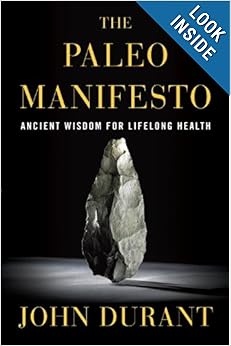
Fame is often accidental.
Some people grind away for years or decades, gaining fans a few at a time through a combination of talent and relentless self-promotion in the face of continual bafflement and rejection, until the media are forced to take notice. And some people get a lucky break.
John Durant got that break. Paleo had been around for a while, including at least one best-selling book…but media people don’t like to leave New York City, so when he started a Paleo meetup group there, he instantly became its unofficial media representative. Coverage in the New York Times, the Colbert Report, and the New Yorker ensued.
Fortunately for the Paleo movement and its variants (e.g. the Primal Blueprint, the Perfect Health Diet), John is an educated and articulate spokesman who has resisted repeated attempts to pigeonhole Paleo as “the caveman diet”, while playing just enough footsie with the stereotypes to keep the media entertained—and who also manages the difficult task of rocking long hair and a beard (giving him the necessary caveman cred) without looking like a stoner, hobo, or record store clerk.
What Is The Paleo Manifesto About?
There are dozens of “how-to” Paleo books in the wild. I haven’t read all of them—but I don’t need to be told yet again that gluten and seed oils are bad, and my own explorations of human evolutionary history and the biochemistry of hunger have already gone far deeper into the science than most books intended for a general audience.
Fortunately, instead of yet another diet guide, Durant offers an overview of the entire spectrum of evolutionary discordance—including chapters on fasting, movement, and circadian rhythms. It’s not a reference book (though he provides quite a few references in the Notes and Bibliography): he provides most of the information through a combination of history, interviews, and personal anecdotes.
John himself previews the book and the intention behind it here, so I won’t rehash it. Note this important point: “The paleosphere will read the book first, but is not the primary audience.” It’s a popular book, written for the mainstream, and I’m evaluating it as such.
What Is The Paleo Manifesto?
The book opens with its strength. Part 1 (“Origins”) touches on topics from the diets of zoo gorillas, to Mosaic law, to the first balloonists to reach the upper atmosphere, in an informal, conversational style. We’re left with explicit takeaways: yes, our modern environment differs dramatically from the Paleolithic environment to which we’ve adapted over millions of years (“evolutionary discordance”), and yes, addressing that discordance is likely to improve our mental and physical health. It’s fun to read without feeling dumbed down, and contains some interesting original research.
Part 2 (“Here and Now”) covers topics as diverse as the pathogen-fighting functions of fasting, the importance of sleep and circadian rhythms, and the social function of Crossfit, as well as the standard Paleo dietary prescription. It’s solid and reasonably well-referenced, and John can turn a memorable phrase, e.g.:
- “By rejecting nutrient-dense herder diets in favor of a few stable cereal grains, the conventional advice to “eat low fat” actually means “Eat like a poor, malnourished farmer”…It’s a meal fit for a serf, sold for a princely sum to slavish Whole Foods shoppers.”
- “Encouraging modern women to eat more fat is about as easy as selling them a makeup called Ugly. Better terms for dietary fat would have been “lipids,” “triglycerides,” or “sexy”—as in, “Each spoonful of lard contains 13 grams of sexy.”
On the other hand, I believe Part 2 suffers a bit from repeated changes in tone and technique. The writing ranges from breezy and anecdotal to factual and frankly prescriptive—sometimes within the same chapter—and the contrast can be a bit jarring, especially compared to the smooth flow of Part 1.
It’s worth noting that Durant’s long discussion of the possible adaptive value of Mosaic law, and his account of a multi-day fast undertaken in a Trappist monastery, makes The Paleo Manifesto both relevant to and respectful of religious faith…a difficult balancing act for a book about human evolutionary context.
Part 3 brings the Paleolithic prescription into present time. Again, while the content is strong and John’s writing is compelling, I find the contrast between accounts of personal experience (“Hunting”) and straight-up facts and advocacy (“Gathering”) a bit jarring.
Result: The Paleo Manifesto is a well-executed pop-science book that covers many topics overlooked by typical diet references, but which has incompletely digested a Paleo reference manual like the Primal Blueprint. It’s strongest as popular science, when telling its story through interviews, anecdotes, and historical accounts. Fortunately this comprises the majority of the book, and the remainder is well-executed: I just wish it went down more easily.
Who Should Read The Paleo Manifesto?
While all current sources seem to agree on the basics, their tone, presentation, and intended audience vary dramatically. Most Paleo and Primal books appeal most strongly to those who have already decided to make a substantive change in their lives, and are looking for a clearly-marked path forward: the Perfect Health Diet primarily targets the scientifically oriented, the Primal Blueprint targets the general public (as long as they accept evolution), It Starts With Food primarily targets those with food obsessions.
In contrast, The Paleo Manifesto gives us a view from the mountaintop. We can see all the elements of Paleo life, how they fit together, and how they affect the thoughts and lives of those who commit to it. As such, I can recommend it to those who are interested in learning more about Paleo but aren’t yet ready to commit to any radical change in their own lives, who are familiar with the dietary prescription but haven’t considered other important evolutionary discordances, or whose religious faith is likely to leave them unconvinced (or offended) by long discussions of human evolution. (In other words, most of the world outside the existing Paleo community.)
And if the reader does decide to commit, The Paleo Manifesto contains enough hard information to “go Paleo” without requiring another book.
US residents can help support gnolls.org (at no cost to yourself) by buying The Paleo Manifesto, or anything else, through this link.
(Legally mandated disclaimer: I received a copy of this book for free.)
It’s both surprising and embarrassing that humans, with our big brains, are the only animals that don’t seem to know what they ought to eat. How did we get here—and, most importantly, what can we do about it?
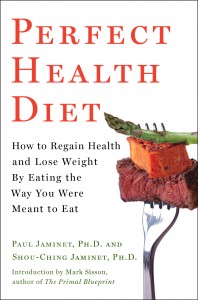
What Is The Perfect Health Diet?
The Perfect Health Diet is much more than a weight loss plan. In the words of the authors, Dr. Paul and Dr. Shou-Ching Jaminet:
“We believe that:
- Nearly all diseases can be cured if they are attacked at their root causes: toxic foods, malnutrition, and chronic infections.
- Nearly everyone can achieve a healthy weight and a long, healthy life by eating as they were meant to eat.”
These are bold claims! Yet in my professional judgment, its lucid explanations based on careful, patient research justify the following assertion:
The Perfect Health Diet is the new baseline from which all future attempts to determine the optimal human diet must be argued and measured.
How Does The Perfect Health Diet Work?
I’ve often described my own approach to nutrition as an attempt to combine archaeology (evidence from the past) with biochemistry (evidence of the present) , using each to fill in what we don’t yet know or understand of the other.
The PHD (as I’ll refer to it henceforth, for brevity) takes a similar approach: it uses what we know of human evolutionary context (and of modern hunter-gatherer diets) as a starting point—but unlike most “Paleo” diet books, it moves quickly forward to the present.
The central concept of the book is: for each nutrient necessary for human life, there is a peak health range for its consumption. Too little of a nutrient causes poor health due to deficiency, and too much causes poor health due to toxicity. (Even water can be toxic if we drink enough of it!)
So, the authors set out to find the peak health range for every known necessary nutrient. From this knowledge, they choose a range of whole foods (and approximate quantities in which to consume them) that bring the known nutrients into the peak health range, while keeping toxic antinutrients below their threshold of toxicity (usually by eliminating them altogether).
This emphasis on whole foods distinguishes the PHD from many other scientific, reductionistic approaches: the Jaminets understand and accept that we don’t know (and, perhaps, can’t know) every substance necessary for human life.
“Food is full of nutrients that we don’t know we need. We share a common biology with plants and animals, and their tissues contain premade biological compounds that are valuable to us and that we may not be able to construct in adequate quantities from purified nutrients.” -pp. 66-67
The bulk of the book is devoted to finding the peak health ranges for macronutrients (Part II), micronutrients (Part IV)—and antinutrients, whose peak health range is often zero (Part III). (I personally find Part IV extremely illuminating, as it identifies several micronutrients in which we can easily become deficient even with careful eating, and recommends a small, carefully chosen list of supplements in response.)
When referring to human diet and metabolism, “macronutrients” are nutrients that can be burned for energy: protein, fat, carbohydrate. (The calorie content of a food is due to macronutrients.)
“Micronutrients” are required to support metabolism, but cannot be burned for energy: vitamins and minerals. (As such, micronutrients are generally required in much smaller quantities.)
Part V provides specific applications of the PHD to issues from fungal infections, to cancer, to GERD; it explains why cholesterol is a nutrient, not a poison, and what those “cholesterol numbers” really mean; it discusses uses of intermittent fasting and techniques for better sleep…
…and, yes, it includes one very short chapter on weight loss. But by the time you’ve read that far, you’ll have such a solid understanding of nutrition and metabolism that it’ll seem perfectly reasonable for the book to be structured in this way, and you’ll know all you need to in order to reach a healthy weight and body composition.
(Warning: the PHD is not intended to, by itself, give you a “six pack”! But you’ll have a much better chance at it by starting with the PHD, achieving a state of good health and body composition, and only then trying to optimize for sub-10% bodyfat.)
In refreshing contrast to most diet plans, the PHD emphasizes that healthy food should be delicious, because our tastes for nutrients like fat and salt don’t exist to tempt us or make us obese. Our tastes exist to guide us towards the nutrients we need—as long as we choose from evolutionarily appropriate, PHD-approved foods.
The book concludes with a basic meal planning guide (one which, fortunately, admits the reality of going to work), and a pointer to the Recipes section of the Perfect Health Diet website.
How Different Is The New Edition?
I’ve been recommending the original edition of the Perfect Health Diet since long before the first AHS in 2011, so many of my readers are already familiar with it.
Paul Jaminet modestly claims “The Scribner edition is 50% longer; almost half of the material is new. Original material is revised and updated,” but I felt as if I were reading a completely new book. The new edition flows more logically—and though it contains much more information than the old edition, it somehow feels less intimidating. And as a bonus, it’s substantially cheaper despite being printed in hardback!
My verdict: if you’ve read the previous edition and found it useful, the new edition is well worth buying.
What’s In (And Out) Of The Perfect Health Diet?
The prescription will be familiar to anyone in the Paleo and ancestral health community: eat meat, fish, eggs, leafy vegetables, root vegetables and other “safe starches”, and fruits; use natural saturated and monounsaturated fats, like butter, coconut oil, and olive oil, for cooking and flavor; avoid grains, legumes (including peanuts), “vegetable oils”, and refined sugar; don’t forget to eat fatty fish and shellfish, bone broths, and beef liver. Peeled white potatoes and white rice (in moderation) are OK, as is butter and fermented dairy. A few carefully-chosen supplement recommendations round out the diet.
Issues?
I hope it’s clear that I view the new edition of the Perfect Health Diet as an indispensable resource. However, there are some changes I would make.
The most glaring omission: the footnotes don’t exist in the book! A note on the first page of each chapter directs you to a page on the Perfect Health Diet website to find them. While I do enjoy the convenience of being able to click links when I’m online, I strongly dislike having the source of an assertion hidden from me unless I have a computer and an Internet connection right at hand. Frankly, I find this omission disconcerting, and while I understand that having pages almost completely covered in footnotes (as in the old edition) is distracting, I hope Scribner will correct the deficiency by adding endnotes to subsequent printings.
Moving on: while the PHD does briefly discuss tweaking protein intake for longevity or body recomposition, I would like to see more acknowledgment and exploration of biochemical and metabolic individuality, and of the benefits of varying dietary composition over time. For instance, we’re starting to learn a great deal about how various genetic mutations affect our processing and conversion of nutrients, and why some people require more of certain nutrients than others. While we still might not understand exactly why, there are clearly some people with metabolic issues around carbohydrate (even “safe starches”). And not all VLC issues are caused by insufficient starch or solved by more starch.
However, I don’t wish my comments to detract from the fact that the PHD is a masterwork.
Conclusion
It’s difficult to communicate just how comprehensive the new Perfect Health Diet is. You could pick almost any paragraph with a footnote, blow that single study up to book length, add breathless hype and a celebrity endorsement, and start a new fad diet equivalent to hundreds of others that are sitting on bookstore shelves, right now. Reading the PHD exposes both the bankruptcy of mainstream dietary advice, and the poverty of most well-known alternatives (all of which, according to the statistics, fail miserably). Most importantly, it provides us with a credible, science-based alternative that isn’t vulnerable to the typical naive arguments like “But cavemen only lived to age 25” or “That’ll raise my cholesterol.”
The PHD is clearly the product of many years of careful research, real-world testing, and hard work. As I said above, “The Perfect Health Diet is the new baseline from which all future attempts to determine the optimal human diet must be argued and measured.”
In case my point isn’t clear: yes, that means you should buy a copy and read it. Even if you find your own nutritional optimum to lie outside their guidelines, the supplement recommendations alone will save you the price of the book…
…and the wealth of information it contains may allow you, or someone you know and value, to attain perfect health.
You can support gnolls.org by buying the new Perfect Health Diet (or anything else) through this link. It costs you nothing, and I get a small spiff.
(Legal disclaimer: I received a pre-publication copy of the book for free.)

What Is The “Whole 30”?
There are two approaches to “going Paleo”: the “taper off” approach, in which you eliminate non-Paleo foods from your life in multiple steps as you feel ready, and the “boot camp/detox” approach, in which you commit to a completely new diet all at once.
The most vocal and successful proponents of the boot camp/detox approach to Paleo are Dallas and Melissa Hartwig. In their “Whole30” program, you commit to eating 100% strict Paleo for 30 days. No cheat days, no 80/20 rule, no white rice or white potatoes, no exceptions. The purpose of It Starts With Food is simple—to get you to do a Whole 30—and the Hartwigs are betting that your health and life will improve so greatly that you’ll stick with it…
…or at least be cautious about re-introducing non-Whole30 foods, so you can rationally evaluate the effect of each one instead of simply falling off the wagon.
What Distinguishes “It Starts With Food” From The Other Paleo Books Out There?
What distinguishes the different Paleo books isn’t so much their actual dietary recommendations. Sure, the Perfect Health Diet permits white rice and white potatoes, both it and the Primal Blueprint are moderately tolerant of dairy, and there is still a bit of push-pull over optimal fat and carb content…but at the end of the day, everyone agrees that meat and vegetables ought to be the foundation of our diet (plus eggs unless you’re allergic, and fruit in moderation), and that anything containing grains, seed oils, and/or refined sugar is right out.
Therefore, I won’t spend a lot of time on the factual content of It Starts With Food, because it won’t be surprising to anyone in the paleo community—especially if you’ve already read Robb Wolf’s The Paleo Solution, of which ISWF’s middle sections are, in most respects, a less chatty and informal version. (Although ISWF is explicitly saturated fat-tolerant, though not fat-philic, and it’s worth noting that clarified butter gets a hall pass.)
What distinguishes ISWF is the approach it takes to advocacy. For instance, the Perfect Health Diet is primarily based on modern-day biology and biochemistry, and the Primal Blueprint works mostly from an evolutionary context. In contrast, It Starts With Food bases itself on changing your relationship with food, using a tough-love (though not harsh) approach throughout.
“The food you eat either makes you more healthy or less healthy. Those are your two options. There is no food neutral; there is no food Switzerland…” (p. 12)
However, it’s not all whip-cracking and ominous warnings. Aside from the usual promises of better health, relief from sickness, etc.—anecdotes of which are planted throughout the text—Chapter 4 closes with the following promises:
First, you will once again be able to appreciate the natural, delicious flavors (including sweet, fatty, and salty) found in whole foods.
Second, the pleasure and reward you experience when eating that delicious food will once again be closely tied with nutrition, satiation, and satiety—you’ll be able to stop eating because you’re satisfied, not because you’re “full”.
Third, you will never again be controlled by your food. (p. 38)
The Hartwigs maintain these themes throughout: if you eat according to the Whole 30, you ought not to have to count calories, always be hungry, or continually crave cheat foods.
Goal: To Sell You The Whole30
The Hartwigs’ stated goal is to convince you that it’s a good idea to do the Whole30—to be strict Paleo for 30 days straight—without cheating. And since they know that most such New Year’s Resolution-styled efforts end in abject failure, they want to make it as easy for you as they can.
Then, after you’ve been “clean” for 30 days, you can start evaluating your favorite non-Whole30 foods to see what effect their reintroduction has on you.
Does It Succeed?
I think the best argument for trying a Whole30 is found on page 204:
“Think of it like this. You’re allergic to cats, and you own ten of them. One day, fed up with your allergies, you decide to get rid of nine of your cats. Will you feel better?”
And the reason I think this book will succeed in convincing many people to try a Whole30 is primarily because of Chapter 16 (“Meal Planning Made Easy”) and Appendix A (“The Meal Map”). Too many diet books, paleo and otherwise, leave the reader with a giant list of forbidden foods (including everything you eat on a daily basis) and, if you’re lucky, a thinly veiled advertisement for another book with actual recipes in it. “Now what do I do?” you think.
In contrast, these two chapters of ISWF tell you everything you need to complete a Whole30 on your own. Their quantity guidelines are both simple and refreshing (“one to two palm-size servings of protein” … “a meal-size portion is the number of eggs you can hold in one hand”). Even better is their mix-and-match approach to meats, vegetables, spices, and sauces, which allows the reader to create hundreds of their own dishes using the flavor combinations they personally find most palatable.
I’ve been using the “one-skillet cooking” technique for quite a while, and Appendix A has given me several new ideas to try.
(Minor Quibbles)
I do have a couple nits to pick. The information on magnesium left out the important fact that if magnesium citrate gives you the runs, other chelates, like malate and glyclnate, have a much reduced laxative effect. Also, ghee and clarified butter are not the same thing! (To make ghee, you must “toast” the residual proteins before pouring off the pure butterfat.) And while this isn’t a quibble, it’s worth noting that “coconut aminos”—a common ingredient in the recipes—are a soy sauce substitute.
However, this is small stuff.
Conclusion
It Starts With Food successfully balances encouragement, tough love, and a simple yet option-rich meal plan to produce a solid, well-placed motivational kick in the butt. In other words, it’s everything you need to do a Whole30 except your own desire and willingness to try it.
Disclaimer: I received two free copies of this book, and gave one away to a lucky member of the gnolls.org mailing list. And if you buy a copy of It Starts With Food from any of the Amazon links on this page, including this one, I get a small spiff. (At no cost to you…buying stuff through my affiliate links is a great way to make Amazon contribute to gnolls.org. Note that you can buy anything, not just the item you clicked through to.)
|
“Funny, provocative, entertaining, fun, insightful.”
“Compare it to the great works of anthropologists Jane Goodall and Jared Diamond to see its true importance.”
“Like an epiphany from a deep meditative experience.”
“An easy and fun read...difficult to put down...This book will make you think, question, think more, and question again.”
“One of the most joyous books ever...So full of energy, vigor, and fun writing that I was completely lost in the entertainment of it all.”
“The short review is this - Just read it.”
Still not convinced?
Read the first 20 pages,
or more glowing reviews.
Support gnolls.org by making your Amazon.com purchases through this affiliate link:

It costs you nothing, and I get a small spiff. Thanks! -JS
.
 Subscribe to Posts Subscribe to Posts
|
Gnolls In Your Inbox!
Sign up for the sporadic yet informative gnolls.org newsletter. Since I don't update every day, this is a great way to keep abreast of important content. (Your email will not be sold or shared.)
IMPORTANT! If you do not receive a confirmation email, check your spam folder.
|